Story · 2026-10-15
Out of the PM's office, he demanded a cut for using his government contacts. Guilty.
The Supreme Court upheld the conviction, Justice Côté dissenting. The commission was on water systems for First Nations, to be paid to his then girlfriend.
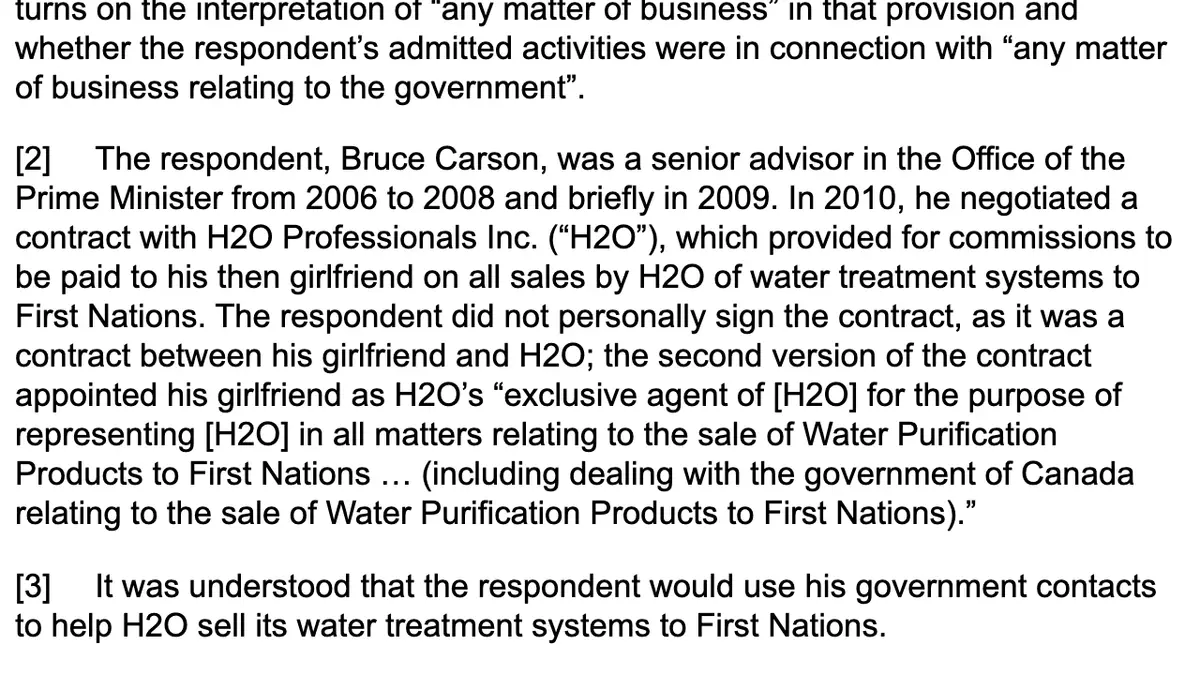
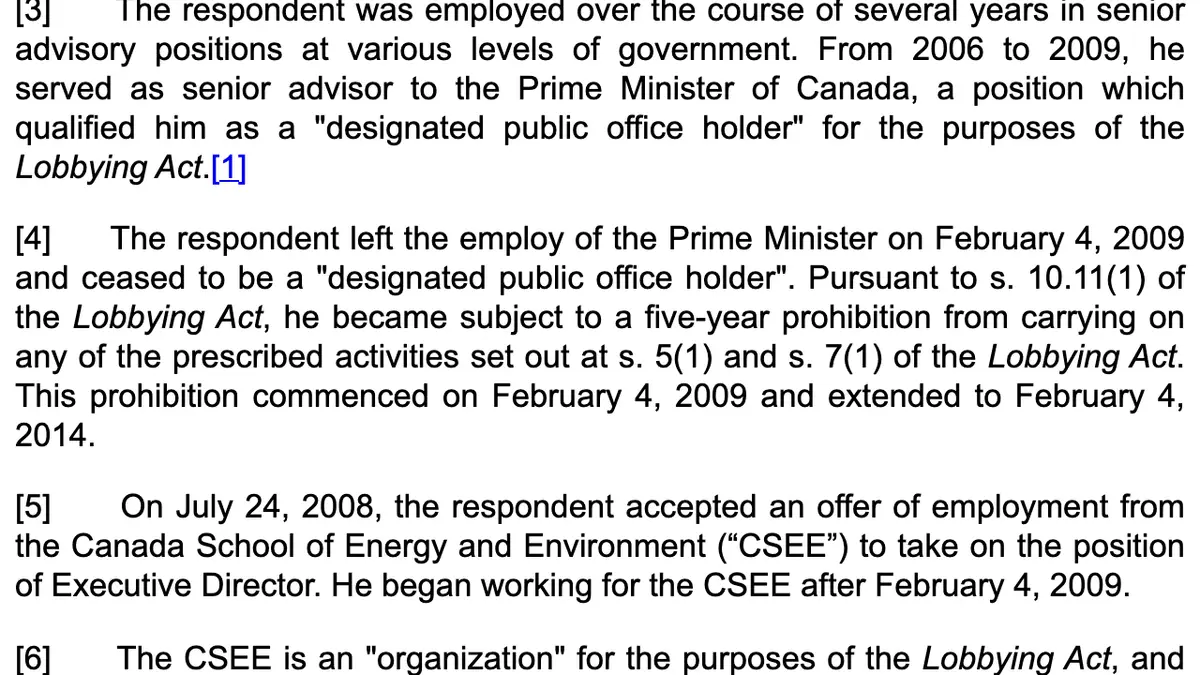
Bruce Carson was a senior adviser in the Prime Minister's Office from 2006 to 2008 and briefly in 2009. The year following his departure, he negotiated an agreement: a water company would pay his then girlfriend commissions on systems sold to First Nations, whether the First Nations or the Government of Canada paid, and he promised to use his government contacts. The courts convicted him of influence peddling, a fraud against the government under the Criminal Code.
Bruce Carson, Senior adviser in the Prime Minister's Office, 2006 to 2008 and briefly in 2009
The product was water treatment systems for homes in First Nations communities. The agreement said the commission was owed whether a First Nation paid for the systems or the Government of Canada did. It was to be paid to the then girlfriend of Bruce Carson, the year following his departure from the Prime Minister's Office.
In exchange, he promised to use his government contacts, and he did. He spoke to First Nations leaders, to officials at Indian and Northern Affairs Canada, and to cabinet ministers and their staff about H2O's products. He "sought to convince INAC to set up a project whereby it would fund the purchase of H2O's products". The money that department spends on water for First Nations is public money.
He admitted at trial that he had influence with the government and that he demanded the benefit in exchange for using his contacts. His defence was that it was not a crime, because First Nations, not Ottawa, decided what to buy. The Supreme Court disagreed: he "undermined the appearance of government integrity."
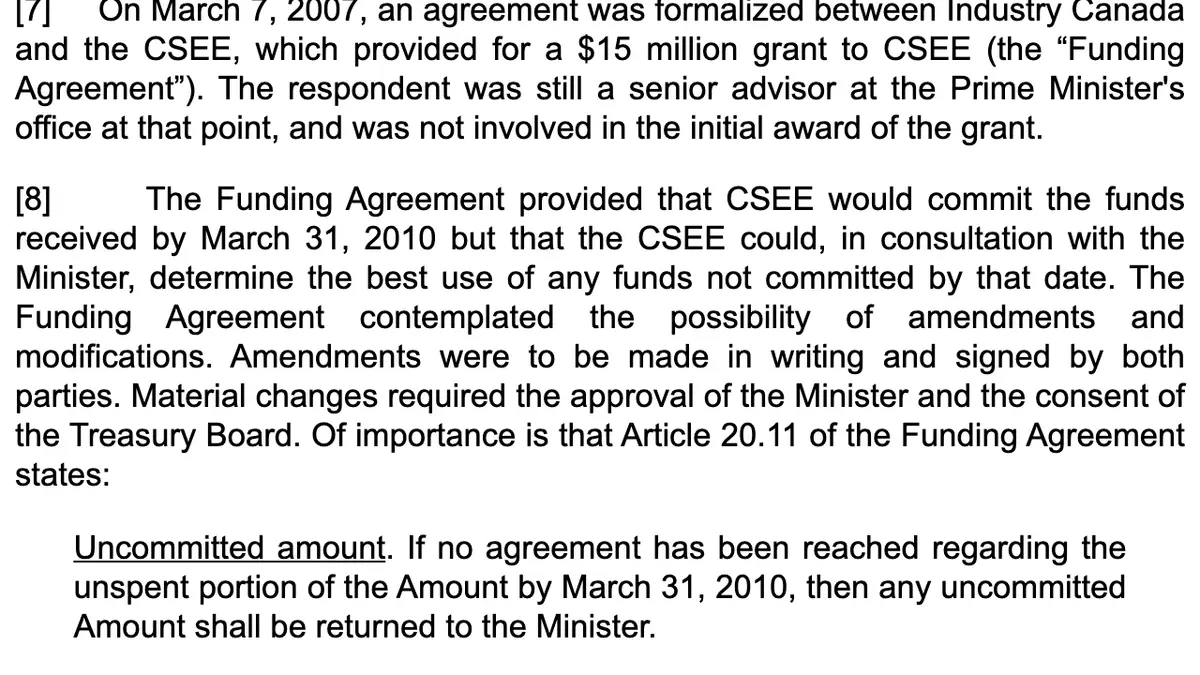
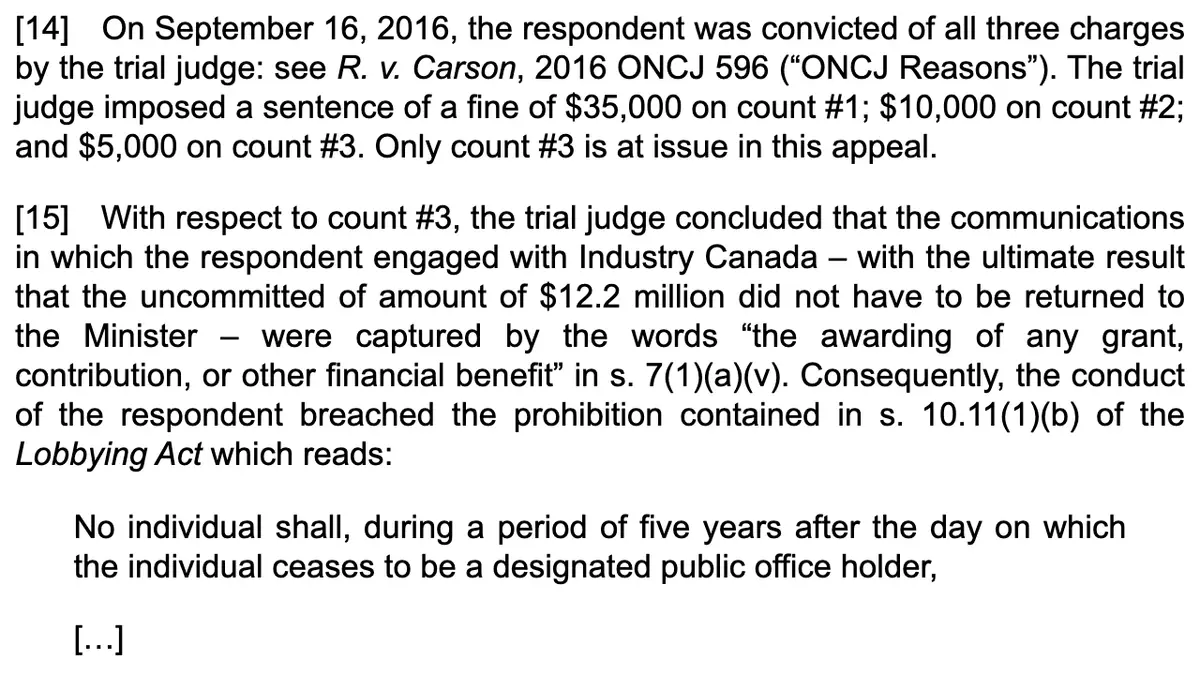
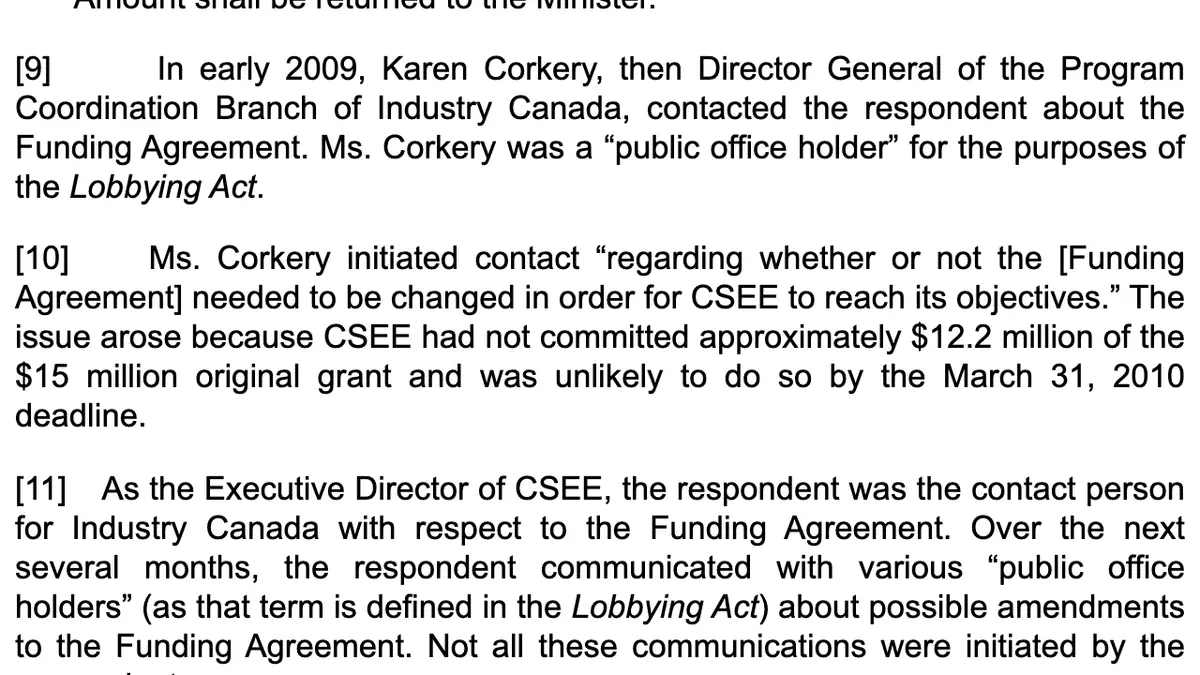
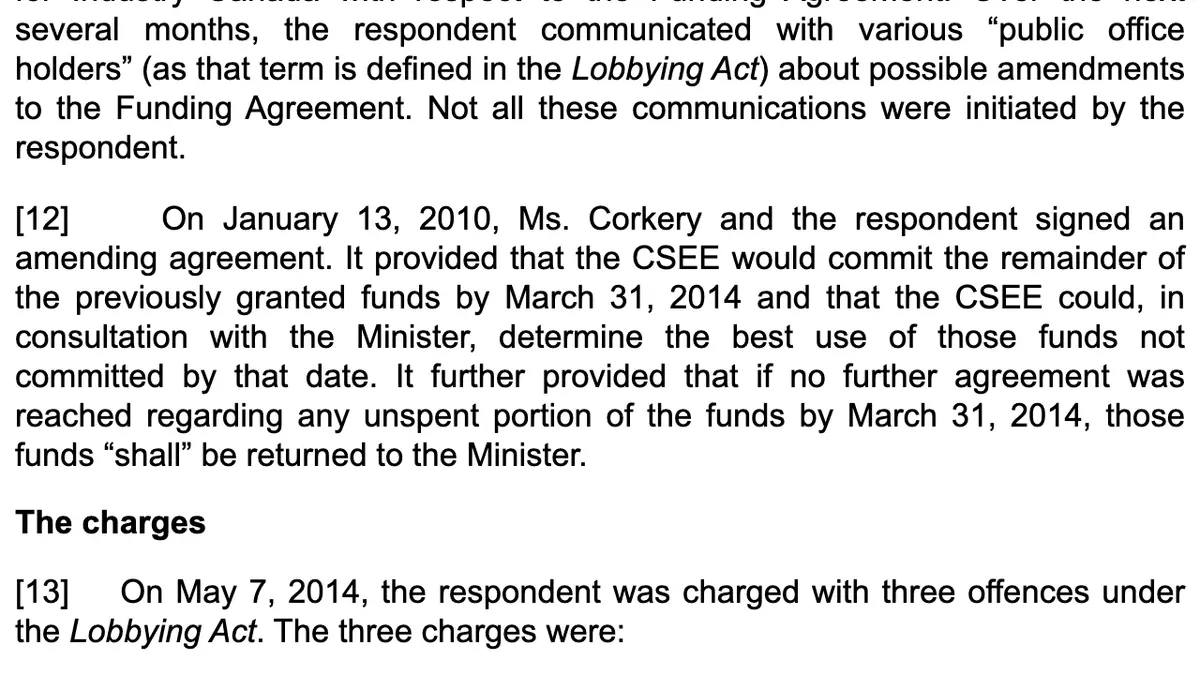
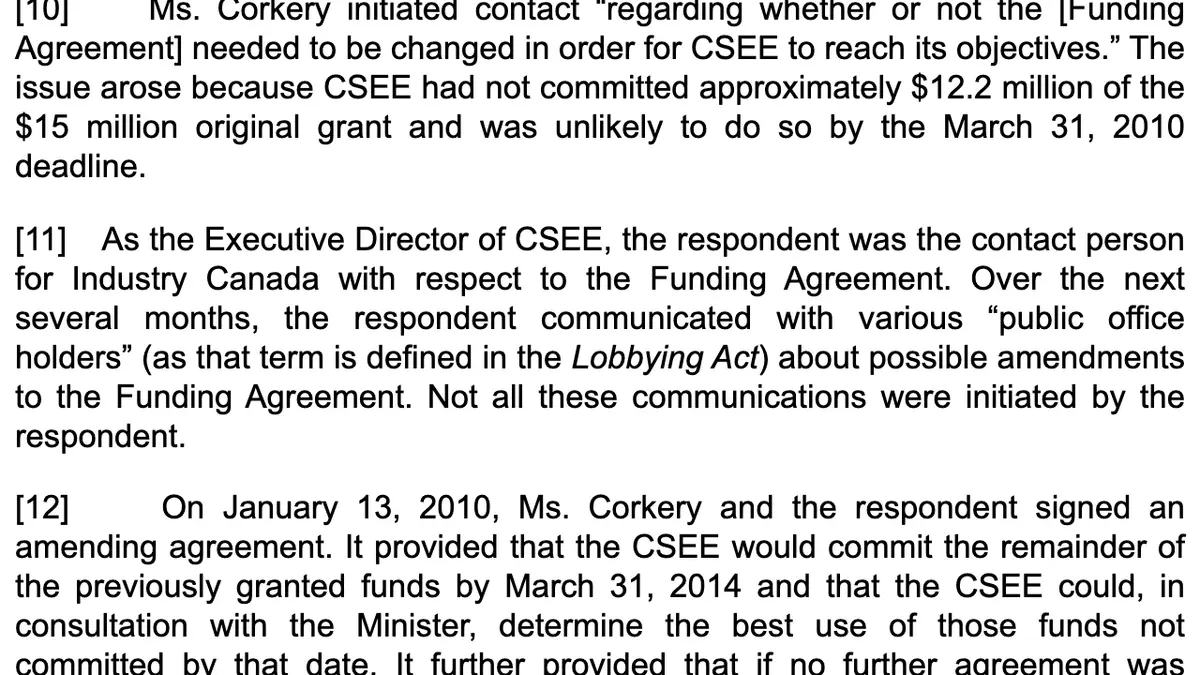
It was not his only conviction. Under the Lobbying Act, a court found that during his five-year ban he undertook, for payment, to communicate with federal officials for the Energy Policy Institute of Canada, and that he communicated with Industry Canada about a federal grant to the school he ran. About $12.2M of it was uncommitted, to be returned to the Minister if no agreement was reached by 31 March 2010. After those talks an amendment set 2014 as the new date to commit it. The trial judge, Justice Catherine Kehoe, found that, as a result, the money "did not have to be returned to the Minister".
Our read
Our read: Bruce Carson put a price on the contacts he had as a senior adviser to the Prime Minister. The year following his departure, he demanded a commission for his then girlfriend in exchange for promising to use his government contacts, on water systems for First Nations that the agreement said the Government of Canada might pay for. At trial, the Supreme Court records, he admitted the influence and the demand; he denied only that his help was "in connection with . . . any matter of business relating to the government".
The close calls in this case were about the law, never the facts. The trial judge acquitted him because First Nations, not the government, decided whether to buy. Justice Simmons in the Court of Appeal and Justice Côté in the Supreme Court dissented. The majority's answer is the one that matters to you: business relates to the government if it "could be facilitated by the government, given its mandate". The Court found the department "could have facilitated these purchases, for example, by changing its funding terms and conditions to H2O's benefit", and he sought to convince it to fund a pilot of that vendor's product.
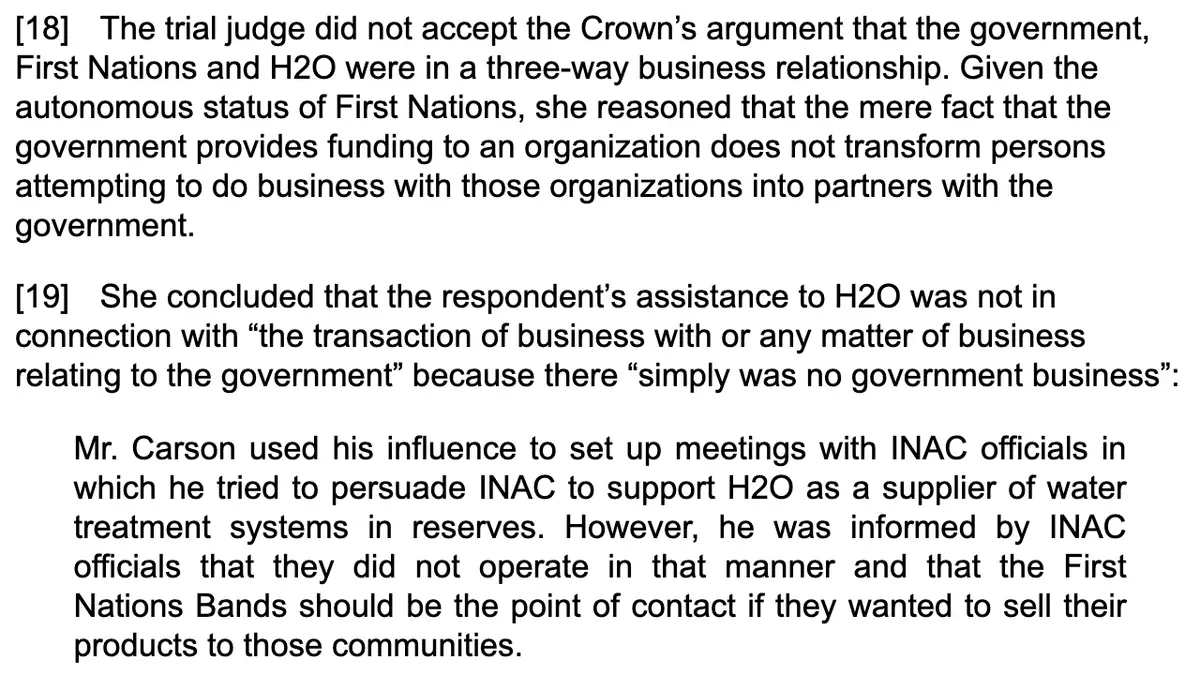
On 22 March 2011 the Prime Minister told the House there was "nothing to indicate" that government money was implicated. His office had already asked the Ethics Commissioner to examine Carson, and its request that day said his emails "appeared to show" he was trying to have federal funding approved. The fraud trial judge, Justice Warkentin, found there "simply was no government business"; the Court of Appeal and the Supreme Court reversed her.
Our read: the conflict was there before H2O. After he accepted the job running the school, the University of Calgary, one of the school's universities, reported lobbying him in the Prime Minister's Office on 2 and 4 September 2008. On 13 January 2009 Harper's chief of staff set a screen around the school, the university and the Networks of Centres of Excellence program; the letters stayed private until 2011. During his five-year ban he did what the ban forbids, and a court convicted him on three counts. The trial judge, Justice Catherine Kehoe, found that, as a result of his communications, about $12.2M of the school's federal grant "did not have to be returned to the Minister". The Globe and Mail reported that he left the office for the school in August 2008; those September filings put him there still, and the record does not settle which is right.
That is the trade the offence exists to stop: contacts made in public office, offered to a company for a commission.
The story
Bruce Carson worked in the Office of the Prime Minister from 2006 to 2008, and briefly in 2009, as a senior adviser. The Court of Appeal and the Supreme Court both record the post.
On 24 July 2008, while still in the Prime Minister's Office, he accepted the job of executive director of the Canada School of Energy and Environment, a collaboration of Alberta's research universities, the University of Calgary among them. The University of Calgary reported lobbying him in the office on education on 2 and 4 September 2008. Others reported lobbying him there that summer: Shell on the environment on 11 July, Petro-Canada on energy on 16 July and on 5 and 15 August, and Hoffmann-La Roche on procurement and health on 28 July. The filings record who met and the subject, not what was said. The Globe and Mail reported he left the office in August 2008; the university's filings list him there in September. The two records do not agree.
He then ran the Canada School of Energy and Environment. In April 2010 he told a Senate committee that the school "was set up in the 2007 budget" as a centre of excellence, and that he took it over "full time after the 2009 budget".
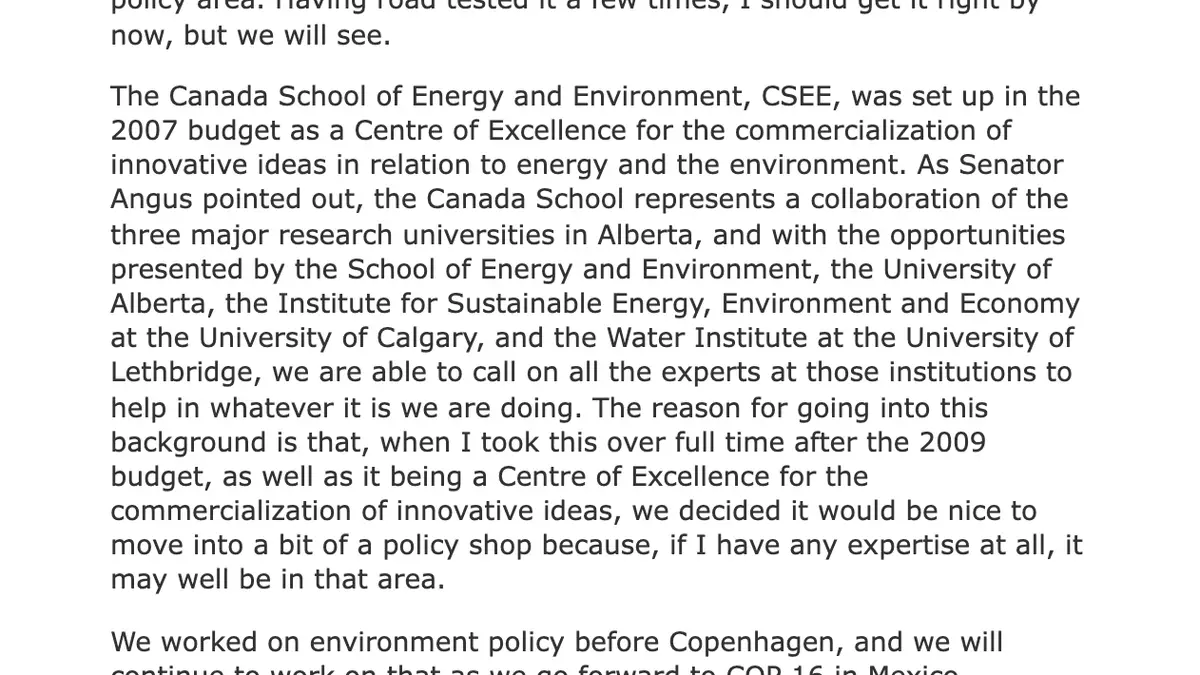
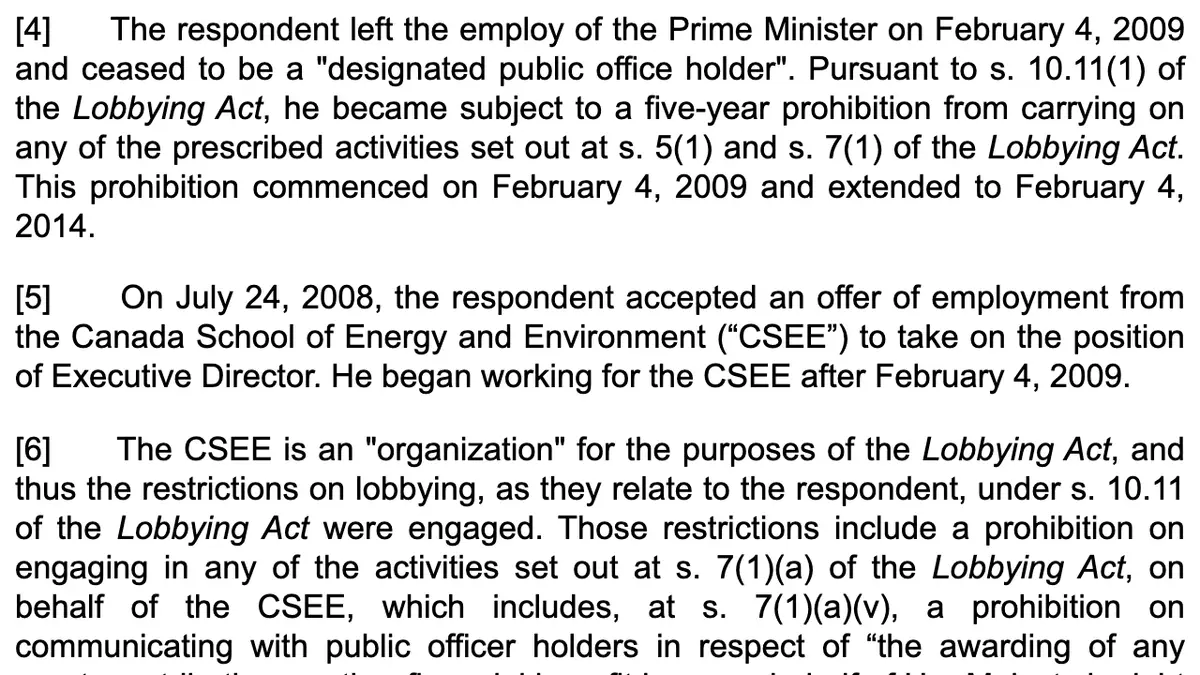
Harper asked him back for a month in January 2009, the Globe reported from the letters the Prime Minister's Office later released. On 13 January Harper's chief of staff, Guy Giorno, set up a screen to keep him out of matters touching the school, the University of Calgary and the Networks of Centres of Excellence program, and stopped his work on the 2009 budget. On 6 January the Natural Resources Department received an email from him "seeking funding for an initiative backed by his other employer, the school". His explanation, in Giorno's letter: it was drafted before he returned "but apparently was mistakenly not sent until after his return to the PMO". "The school recalled the e-mail." Giorno wrote that at the budget meetings he attended, "no matters related to his work at the school were raised." The letters stayed private until April 2011. He left the Prime Minister's employ on 4 February 2009, the Court of Appeal later found, and began work at the school after that date.
- Accepts the job running the school, while in the PM’s officeCourt of Appeal for Ontario, para. 5 ↗
- The University of Calgary reports lobbying him in the PM’s officeOffice of the Commissioner of Lobbying of Canada, communication report 5009-83175, designated public office holders who participated ↗
- Back in the office, a screen goes up around the schoolThe Globe and Mail, Giorno's letters to Ethics Commissioner Mary Dawson ↗
- Leaves the PM’s employ; his five-year lobbying ban beginsCourt of Appeal for Ontario, para. 4 ↗
- He signs an amending agreement on the uncommitted grantCourt of Appeal for Ontario, para. 12 ↗$12,200,000
- His email claims a call with the PM; no finding it happenedOntario Superior Court of Justice, para. 27(a), his email of 6 August 2010 ↗
- His old office asks the Ethics Commissioner to examine himOffice of the Conflict of Interest and Ethics Commissioner, report p. 1, The Request ↗
- Acquitted of influence peddling at trialSupreme Court of Canada, para. 12, citing 2015 ONSC 7127 ↗
- Convicted on three Lobbying Act countsCourt of Appeal for Ontario, para. 14 ↗
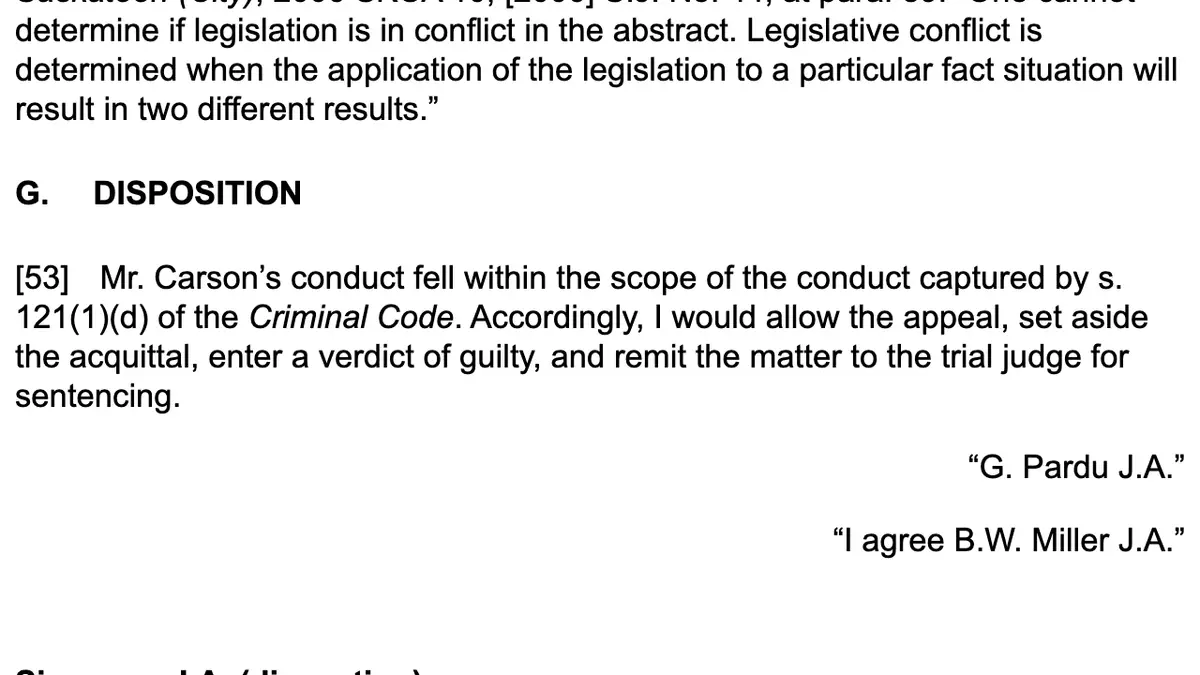
- The Court of Appeal convicts him of influence peddlingCourt of Appeal for Ontario, para. 53 ↗
- The Supreme Court upholds the convictionSupreme Court of Canada, paras. 7 and 8 ↗
- The grant count is reinstatedCourt of Appeal for Ontario, paras. 20 and 26 ↗
The year following his departure from the Prime Minister's Office, he negotiated a contract with "H2O Professionals Inc. (H2O)", in Justice Simmons's words "a company that marketed and sold point-of-use water treatment systems and water softener systems". Commissions would be paid to his then girlfriend on every sale of the systems to First Nations, "regardless of whether the First Nations or the Government of Canada paid for the systems." The Supreme Court's words for his side of it: he "demanded this commission in exchange for promising to use his government contacts to help H2O sell its products to First Nations."
Then he used them. He communicated with First Nations leaders, government officials at Indian and Northern Affairs Canada, and cabinet ministers and their staff about H2O's products. "INAC advised him that it provided funding to First Nations that could be used towards purchasing point-of-use water systems," the Supreme Court found, though "First Nations had full autonomy in determining how to allocate this funding." "That said, INAC sometimes participated in and funded pilot projects for water treatment systems." He "sought to convince INAC to set up a project whereby it would fund the purchase of H2O's products to pilot them in First Nations communities."
The trial judge's findings show how. On 6 August 2010 he emailed H2O's owners: "I spoke with the PM last nite and with Atleo- the movement of John Duncan to INAC does not slow anything down." That is his claim in an email; the court made no finding that the call took place. Department officials who met him and H2O that autumn told them point-of-use systems "would be purchased by First Nations communities". On 16 September 2010 he wrote to the Assembly of First Nations' chief executive that "the govt has decided to fund the systems". The AFN's water specialist told him the AFN "does not endorse any product". He asked H2O to buy a table at the AFN's Christmas dinner; the money was paid to him, and he gave it to his then girlfriend. "The AFN was never paid." In May 2011, after the Canadian Press reported that John Duncan's aides had met Carson in January, Duncan's spokeswoman said: "they met him once, and nothing was untowards". The trial judge found that between January and March 2011 he met Duncan, then Minister of Indian and Northern Affairs, and Peter Kent, then Minister of the Environment, with their staff, "to discuss the means by which H2O's water treatment systems could be funded". Neither the trial reasons, 2017 ONCA 142, 2018 SCC 12 nor the Ethics Commissioner's report finds what either minister knew of the commission.
That is the pattern: a commission to his then girlfriend, the Government of Canada named as a possible payer, and a push for the department to fund his client's product.
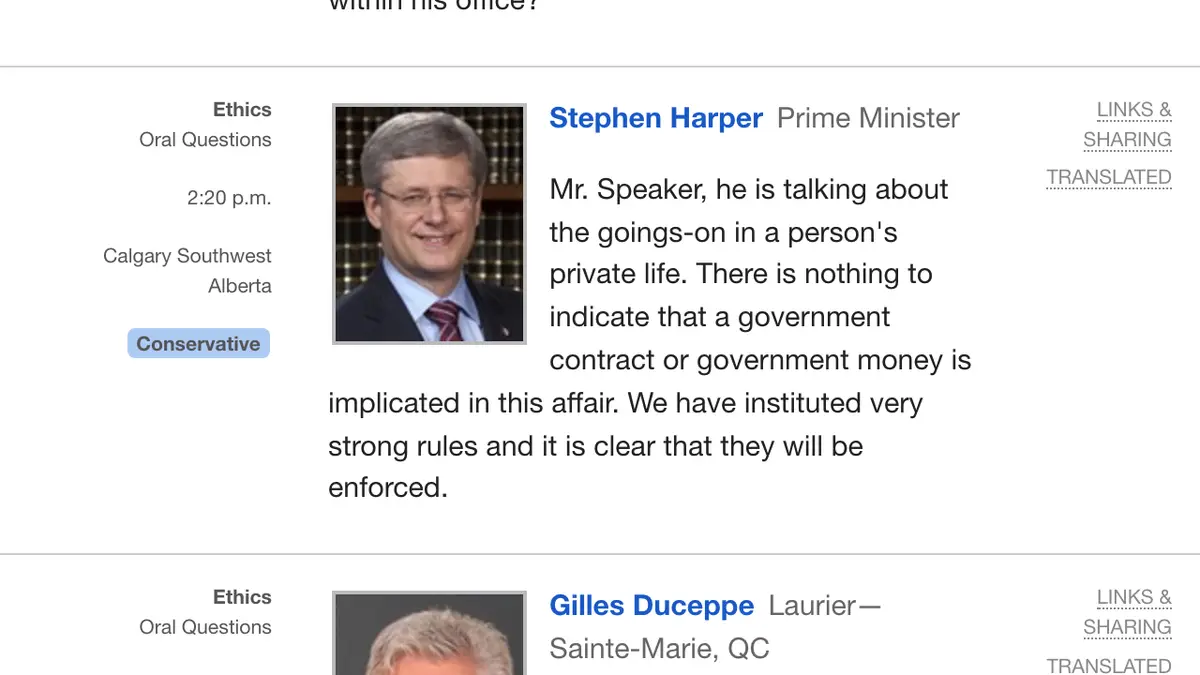
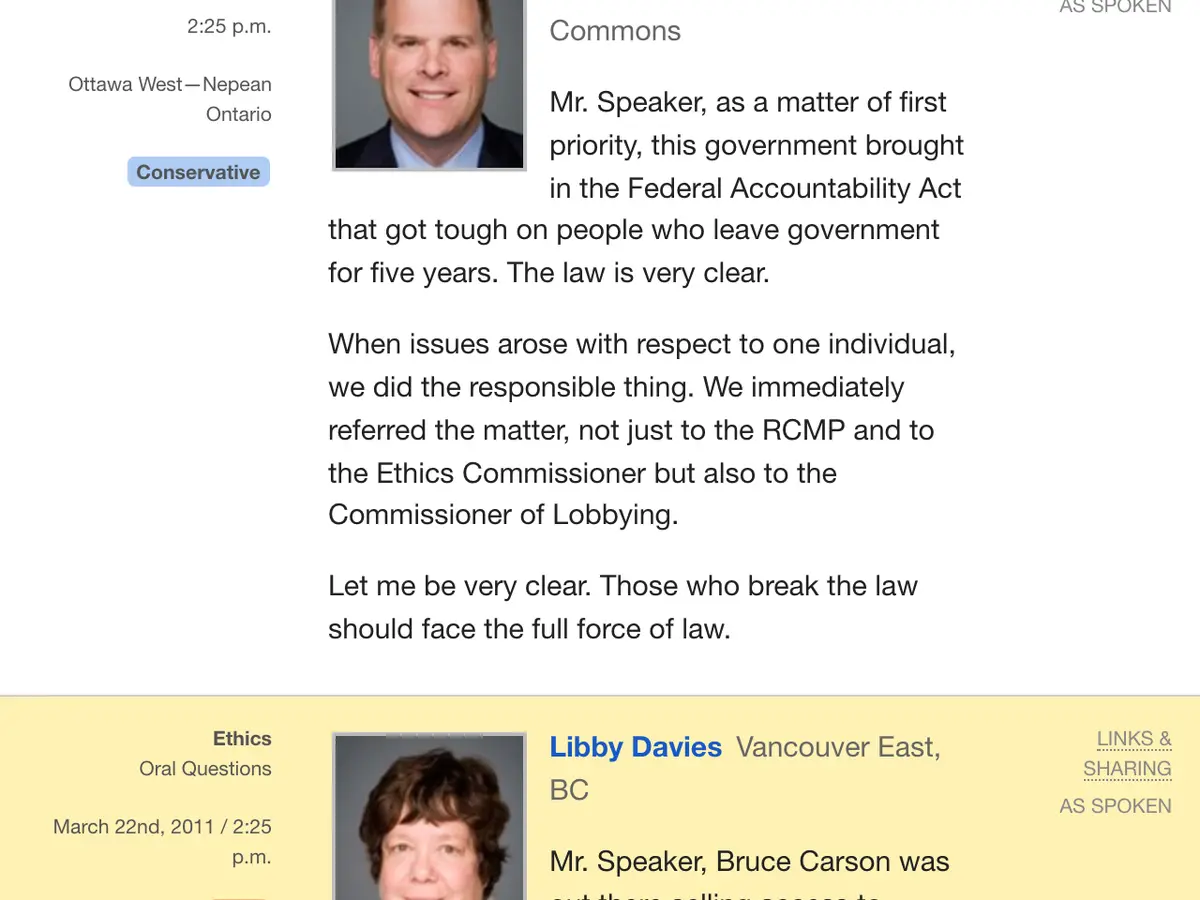
In March 2011 his old office referred him. On 12 March Harper's chief of staff, Ray Novak, wrote to the Ethics Commissioner on the Prime Minister's behalf asking for an examination of Carson's conduct. A second request, from Dimitri Soudas, the office's director of communications, on 22 March, said his emails with the department "appeared to show that Mr. Carson was trying to use his influence to have federal funding approved". That day Harper told the House: "There is nothing to indicate that a government contract or government money is implicated in this affair." John Baird said the government had referred the matter "not just to the RCMP and to the Ethics Commissioner but also to the Commissioner of Lobbying." The trial judge later found there "simply was no government business"; the Court of Appeal set the acquittal aside, and the Supreme Court upheld the conviction. The ethics examination opened on 1 April 2011 and was suspended on 14 November 2011 for the RCMP's criminal investigation. Commissioner Mario Dion closed it in June 2018 without a finding, "especially given the guilty verdict".
He was charged with a fraud against the government under section 121(1)(d) of the Criminal Code, the influence peddling offence. At trial, the Supreme Court records, he admitted he was a person with influence with the government, and that he demanded a benefit for his then girlfriend in exchange for using his contacts for H2O. His defence was that this was not connected to "any matter of business relating to the government", because First Nations, not the department, decided whether to buy. The trial judge, Justice Warkentin of the Ontario Superior Court, agreed, and acquitted him in 2015.
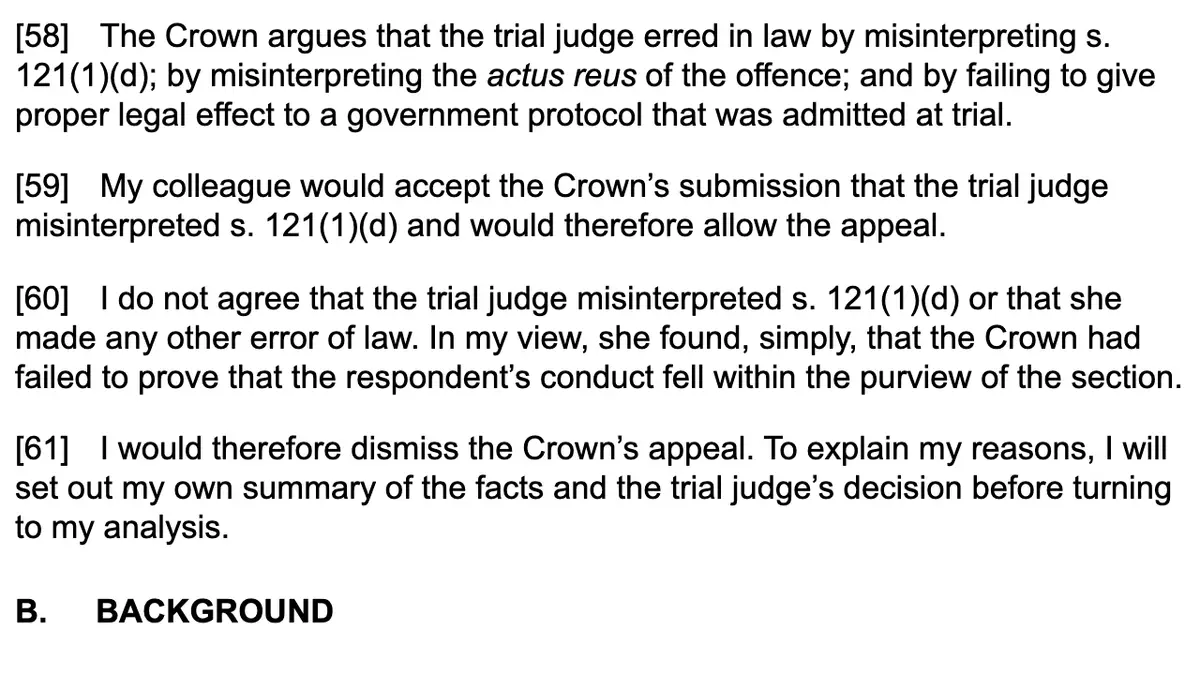
The Crown appealed. On 17 February 2017 the Court of Appeal for Ontario held that the trial judge had read the offence too narrowly, entered a verdict of guilty and sent the case back for sentencing. Justice Simmons dissented: "I do not agree that the trial judge misinterpreted s. 121(1)(d) or that she made any other error of law."
On 23 March 2018 the Supreme Court of Canada dismissed his appeal, with Justice Côté dissenting. Justice Karakatsanis wrote that the department "could have facilitated these purchases, for example, by changing its funding terms and conditions to H2O's benefit," and that "Mr. Carson tried to convince the government to create a pilot project to promote H2O's products." Her conclusion: by demanding a benefit in exchange for his promise of influence, "Mr. Carson undermined the appearance of government integrity."
Justice Côté dissented. In her view the business had to relate to the government in fact, and here it did not.
The majority's reasons are now the law. In the Court's words, a matter of business relates to the government "if it depends on or could be facilitated by the government, given its mandate." The trial judge had found First Nations could buy such systems "without INAC's approval". The conviction stands all the same.
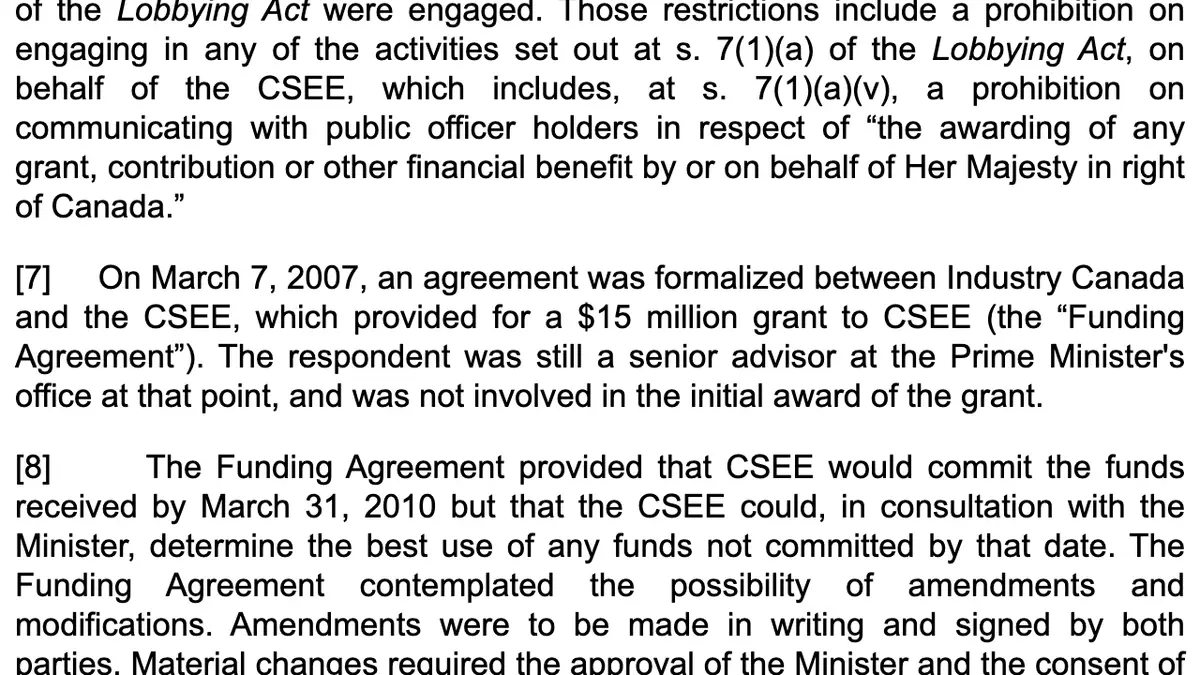
His second case was under the Lobbying Act. Leaving the Prime Minister's employ on 4 February 2009 put him under a five-year ban, to 4 February 2014. The school he now ran had a $15.0M grant from Industry Canada, agreed on 7 March 2007 while he was still in the Prime Minister's Office; the court found he had no part in that award. If no agreement on the unspent money was reached by 31 March 2010, the uncommitted part "shall be returned" to the Minister; the school could also, with the Minister, decide its best use. In early 2009 an Industry Canada director general contacted him: about $12.2M was uncommitted and unlikely to be committed in time. Over the following months he communicated with officials about changing the agreement, and on 13 January 2010 an amendment set 31 March 2014 as the date to commit the rest.
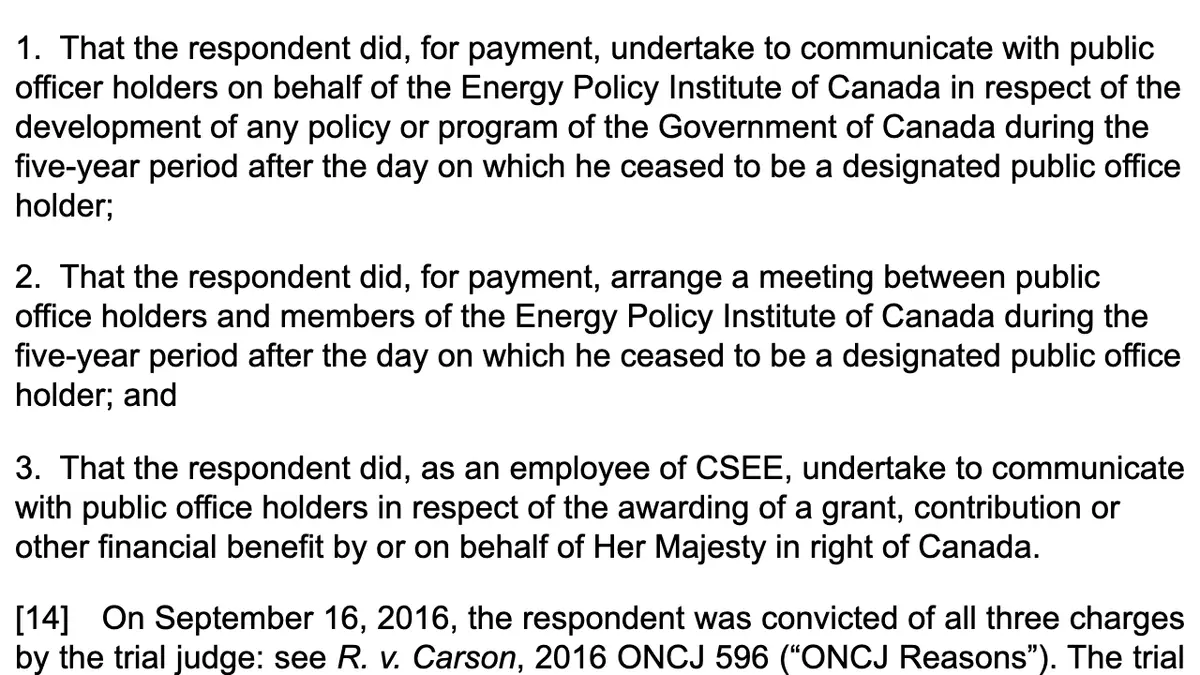
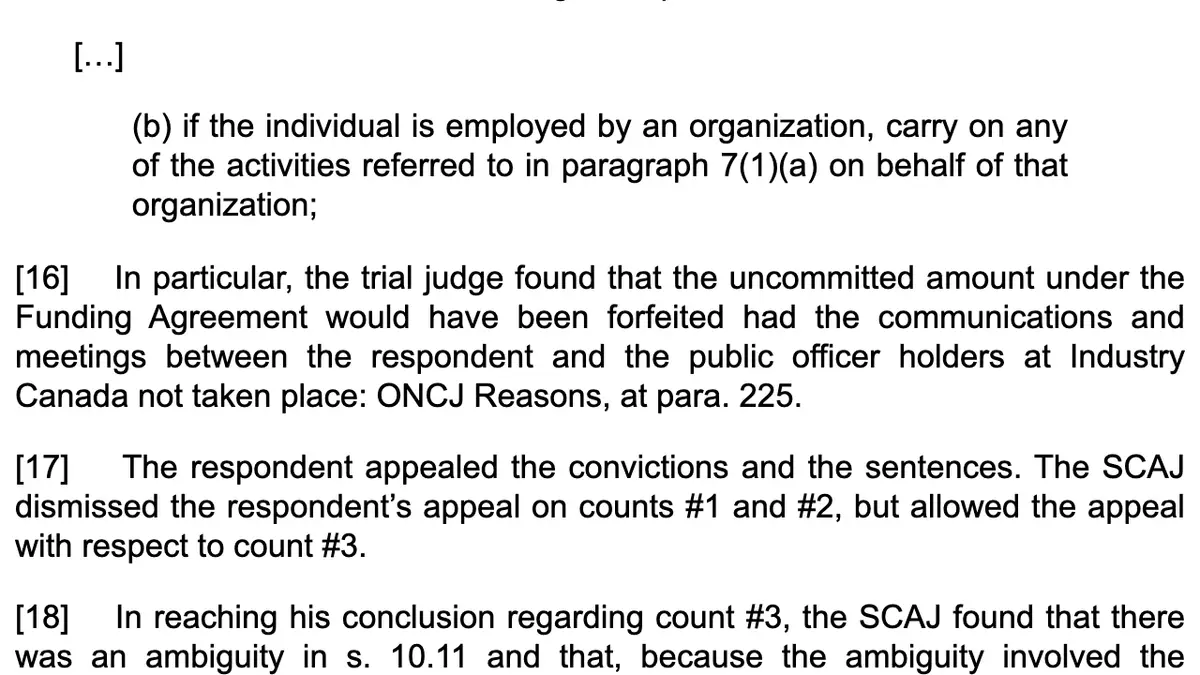
He was charged on 7 May 2014 with three offences: undertaking, for payment, to communicate with officials on behalf of the Energy Policy Institute of Canada about government policy; arranging, for payment, a meeting between officials and its members; and communicating, as the school's employee, about a federal grant. Justice Catherine Kehoe of the Ontario Court of Justice convicted him on all three on 16 September 2016, and that November fined him $50,000 in all. She found that, as a result of his communications, the money "did not have to be returned to the Minister", and that it "would have been forfeited" without them.
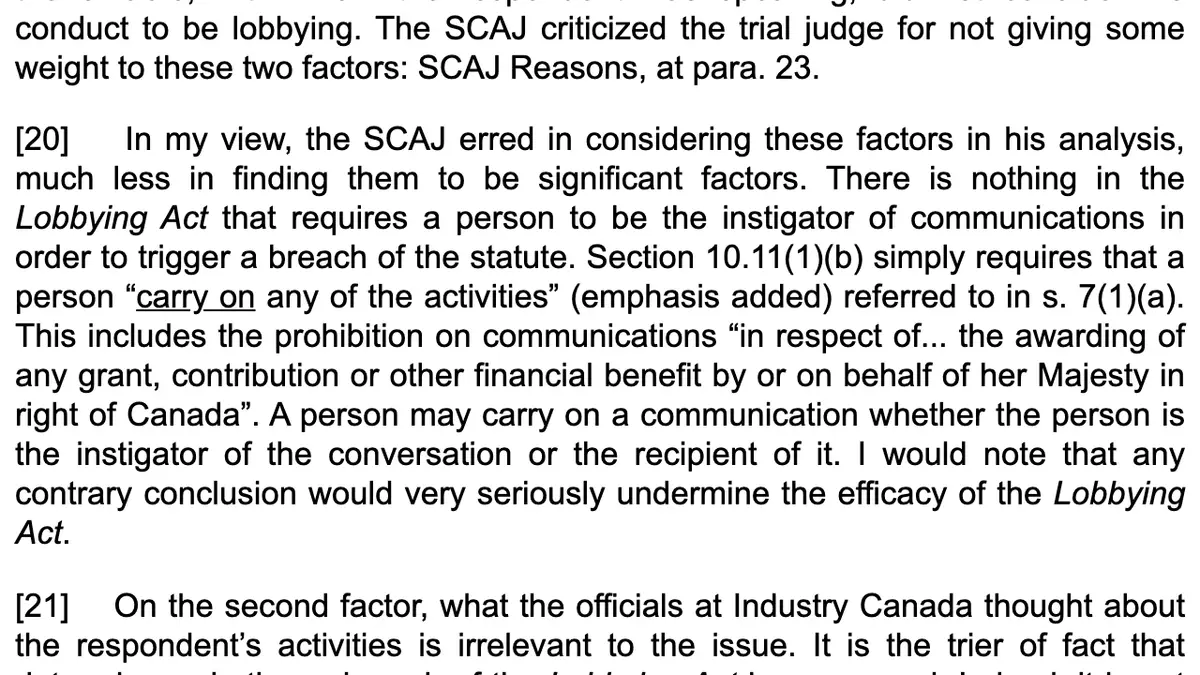
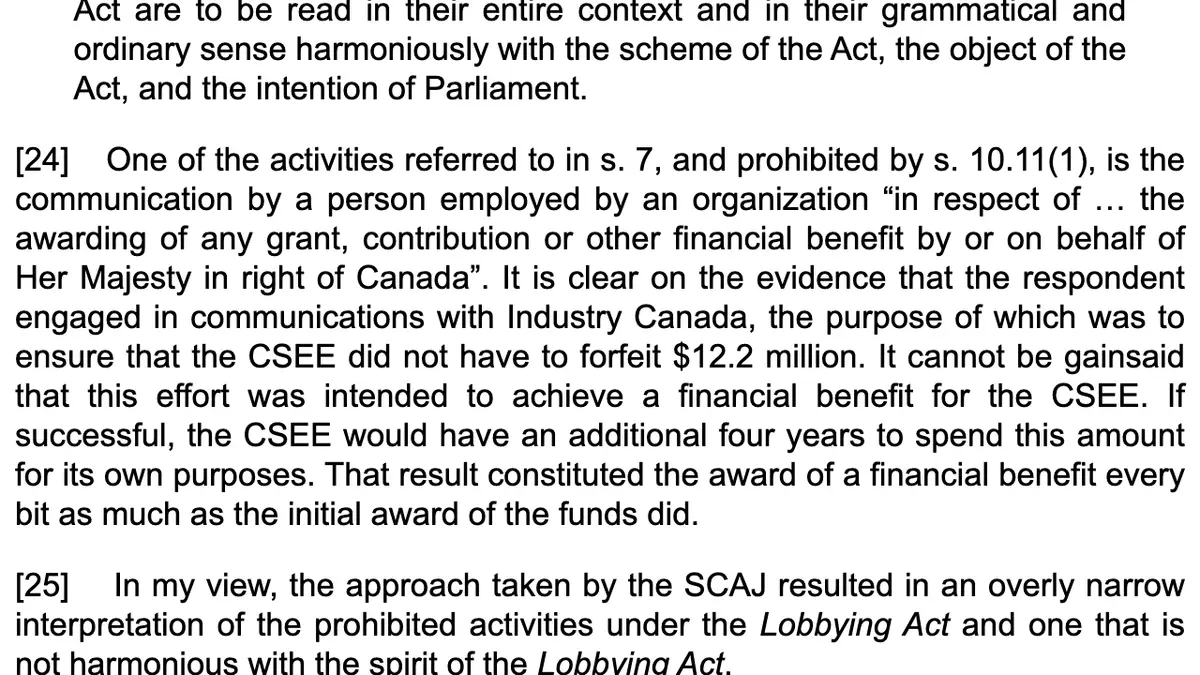
On appeal in 2017, Justice Calum MacLeod of the Superior Court of Justice set aside the grant count: answering officials' questions about a grant already awarded "is not clearly engaging in" communication on the award of one, he held. On 15 May 2019 the Court of Appeal for Ontario reinstated it: "A person may carry on a communication whether the person is the instigator of the conversation or the recipient of it." The extension, the court held, "constituted the award of a financial benefit every bit as much as the initial award of the funds did."
Their side
His case was never that the deal didn't happen. At trial, in the Supreme Court's words, he "took the position that his assistance was not 'in connection with a matter of business relating to the government'", because First Nations, not Ottawa, decided whether to buy water systems. In the Supreme Court he submitted that the trial judge correctly interpreted the offence to exclude matters in which the government has no direct interest. The trial judge agreed with him and acquitted him. Justice Simmons, dissenting in the Court of Appeal, found no error of law in that acquittal. Justice Côté, dissenting in the Supreme Court, held the business had to relate to the government in fact: "In my view, he did not."
His old office's side, in its own words. On 22 March 2011 the Prime Minister told the House: "There is nothing to indicate that a government contract or government money is implicated in this affair." His office had already asked the Ethics Commissioner to examine Carson, by Ray Novak's letter of 12 March; Dimitri Soudas's request of 22 March said the emails "appeared to show that Mr. Carson was trying to use his influence to have federal funding approved". The trial judge accepted that there "simply was no government business". The Court of Appeal reversed her, and the Supreme Court upheld the conviction: business relates to the government "if it depends on or could be facilitated by the government, given its mandate." Guy Giorno wrote that at the budget meetings he attended, "no matters related to his work at the school were raised." In the second case, the appeal judge set aside the grant count partly because Industry Canada began the talks and its officials did not consider his conduct lobbying. The Court of Appeal held that neither point mattered under the Act.
- Supreme Court of Canada: R. v. Carson, 2018 SCC 12, para. 3
- Supreme Court of Canada: R. v. Carson, 2018 SCC 12, para. 21
- Supreme Court of Canada: R. v. Carson, 2018 SCC 12, para. 21
All 12 sources
- Court of Appeal for Ontario: R. v. Carson, 2017 ONCA 142, paras. 60 and 61, Simmons J.A., dissenting
- Supreme Court of Canada: R. v. Carson, 2018 SCC 12, para. 51, Côté J., dissenting
- House of Commons (openparliament.ca): House of Commons Debates, 22 March 2011, Ethics, Stephen Harper, 2:20 p.m.
- Court of Appeal for Ontario: R. v. Carson, 2017 ONCA 142, para. 19
- The Globe and Mail: Top Harper aide flagged Bruce Carson to Ethics Commissioner, Giorno's letters to Ethics Commissioner Mary Dawson
- Court of Appeal for Ontario: R. v. Carson, 2019 ONCA 396, para. 19
- Office of the Conflict of Interest and Ethics Commissioner: Carson Report: Discontinuance of an Examination made under the Conflict of Interest Act, report p. 1, The Request
- Office of the Conflict of Interest and Ethics Commissioner: Carson Report: Discontinuance of an Examination made under the Conflict of Interest Act, report p. 1, The Request
- Supreme Court of Canada: R. v. Carson, 2018 SCC 12, para. 5
The answer
Our read: the department did not have to approve a purchase to shape it. The Supreme Court's test is whether the business "depends on or could be facilitated by the government, given its mandate". It found the department "could have facilitated these purchases, for example, by changing its funding terms and conditions to H2O's benefit", and that it "sometimes participated in and funded pilot projects". Carson sought to convince it to set up one for H2O. A promise to use government contacts for one vendor, in exchange for a commission, is what the offence forbids. The Supreme Court said so, with Justice Côté dissenting. The Lobbying Act case turned the same way: the Court of Appeal held a communication counts "whether the person is the instigator of the conversation or the recipient of it."
What we are chasing
- What sentence did the court impose for the influence peddling?Would settle it: The Ontario Superior Court of Justice's sentencing reasons of 2018, or the Public Prosecution Service's record of the case.
- Did any H2O system reach a First Nation with federal money, and was any commission paid?Would settle it: The trial reasons and exhibits, 2015 ONSC 7127, and the department's pilot project files, by an access request to Indigenous Services Canada.
- When did he leave the Prime Minister's Office in 2008? The University of Calgary's filings list him there on 4 September; the Globe reported he left in August.Would settle it: The Prime Minister's Office's record of his employment dates, by an access request to the Privy Council Office.
- What did either minister know of the commission when they met him between January and March 2011?Would settle it: The trial exhibits in 2015 ONSC 7127 and the RCMP's investigation file.
- Did he speak with the Prime Minister on 5 August 2010, as his email claimed?Would settle it: The Prime Minister's call and meeting records for that date, by an access request to the Privy Council Office.
- Whom did he meet for the Energy Policy Institute of Canada, who were its paying members, and what did it pay him?Would settle it: The trial reasons in R. v. Carson, 2016 ONCJ 596, and the institute’s member lists for 2010 and 2011.
- What did the school commit the rest of the grant to by 31 March 2014?Would settle it: The amending agreement of 13 January 2010 and the school's reports to Industry Canada, by an access request to Innovation, Science and Economic Development Canada.
- Were the Lobbying Act fines paid?Would settle it: The Ontario Court of Justice's fine records for R. v. Carson, 2016 ONCJ 596.
The receipts
Each fact with its document and date. Tap a figure for its source.
The office he left
- He was a senior adviser in the Office of the Prime Minister from 2006 to 2008, and briefly in 2009. “a senior advisor in the Office of the Prime Minister from 2006 to 2008 and briefly in 2009”Court of Appeal for Ontario, para. 2 (2017-02-17) ↗
2 more receipts, 2 to 3
- In April 2010 he appeared before a Senate committee as executive director of the Canada School of Energy and Environment, which he said was set up in the 2007 federal budget. “The Canada School of Energy and Environment, CSEE, was set up in the 2007 budget as a Centre of Excellence”Senate of Canada, Bruce Carson, Executive Director, Canada School of Energy and Environment (2010-04-13) ↗
- He told the committee he took the school over full time after the 2009 budget. “when I took this over full time after the 2009 budget”Senate of Canada, Bruce Carson, Executive Director, Canada School of Energy and Environment (2010-04-13) ↗
- On 24 July 2008, while still in the Prime Minister's Office, he accepted the school's offer to become its executive director. “the respondent accepted an offer of employment from the Canada School of Energy and Environment (CSEE) to take on the position of Executive Director”Court of Appeal for Ontario, para. 5 (2019-05-15) ↗
- The Globe and Mail reported that he left the office in August 2008. “had left the Prime Minister's Office in August, 2008.”The Globe and Mail, the letters released by the Prime Minister’s Office (2011-04-20) ↗
2 more receipts, 6 to 7
- The Court of Appeal found, in his second case, that he left the Prime Minister's employ on 4 February 2009. “The respondent left the employ of the Prime Minister on February 4, 2009”Court of Appeal for Ontario, para. 4 (2019-05-15) ↗
- It found he began work at the school after that date. “He began working for the CSEE after February 4, 2009.”Court of Appeal for Ontario, para. 5 (2019-05-15) ↗
A senior adviser in the Prime Minister's Office from 2006 to 2008 and briefly in 2009. He accepted the school's job on 24 July 2008, while still there. When he left the office that year, the records do not agree.
Lobbied in the Prime Minister's Office
- Shell Canada reported lobbying him in the Prime Minister's Office on the environment on 11 July 2008. “Communication date: 2008-07-11 … Bruce Carson, Senior Advisor Prime Minister's Office, Prime Minister's Office (PMO) … Subject Matter of the communication: Environment”Office of the Commissioner of Lobbying of Canada, communication report 16637-77382, designated public office holders who participated ↗
- Shell Canada reported lobbying him in the Prime Minister's Office on the environment on 11 July 2008Office of the Commissioner of Lobbying of Canada, communication report 16637-77382, designated public office holders who participated ↗
- Petro-Canada reported lobbying him there on energy on 16 July, 5 August and 15 August 2008Office of the Commissioner of Lobbying of Canada, communication reports 5144-83634, 83635 and 83636 (2008-07-16, 2008-08-05 and 2008-08-15), each with the same line ↗
- It reported lobbying him again on 4 September 2008, naming him a senior adviser in the officeOffice of the Commissioner of Lobbying of Canada, communication report 5009-83175, designated public office holders who participated ↗
- Hoffmann-La Roche reported lobbying him there, as policy adviser to the Prime Minister, on government procurement and health on 28 July 2008. “Communication date: 2008-07-28 … Bruce Carson, Policy Advisor to Prime Minister Harper Prime Minister's Office (PMO) … Subject Matter of the communication: Government Procurement, Health”Office of the Commissioner of Lobbying of Canada, communication report 64-77233, designated public office holders who participated ↗
4 more receipts, 10 to 13
- Petro-Canada reported lobbying him there on energy on 16 July, 5 August and 15 August 2008. “Communication date: 2008-07-16 … Bruce Carson, Senior Advisor Prime Minister's Office (PMO) … Subject Matter of the communication: Energy”Office of the Commissioner of Lobbying of Canada, communication reports 5144-83634, 83635 and 83636 (2008-07-16, 2008-08-05 and 2008-08-15), each with the same line ↗
- The school, he later told Senators, is a collaboration of the major research universities in Alberta, with an institute at the University of Calgary among its parts. “a collaboration of the three major research universities in Alberta … the Institute for Sustainable Energy, Environment and Economy at the University of Calgary”Senate of Canada, Bruce Carson, Executive Director, Canada School of Energy and Environment (2010-04-13) ↗
- The University of Calgary reported lobbying him in the Prime Minister's Office on education on 2 September 2008. “Communication date: 2008-09-02 … Bruce Carson, Senior Advisor Prime Minister's Office (PMO) … Subject Matter of the communication: Education”Office of the Commissioner of Lobbying of Canada, communication report 5009-83174, designated public office holders who participated ↗
- It reported lobbying him again on 4 September 2008, naming him a senior adviser in the office. “Communication date: 2008-09-04 … Bruce Carson, Senior Advisor Prime Minister's Office (PMO) … Subject Matter of the communication: Education”Office of the Commissioner of Lobbying of Canada, communication report 5009-83175, designated public office holders who participated ↗
The University of Calgary, part of the school whose job he had accepted, reported lobbying him in the Prime Minister's Office on 2 and 4 September 2008. The filings record who met and the subject, not what was said. They list him in the office in September 2008; the Globe has him gone in August. The two records do not agree.
The screen
- Harper asked him back to the office for a month in January 2009. “Mr. Harper asked for him to come back for a month in January, 2009.”The Globe and Mail, the letters released by the Prime Minister’s Office (2011-04-20) ↗
- Harper's chief of staff, Guy Giorno, set up a screen from 13 January 2009 to keep him out of matters touching the school, the University of Calgary and the Networks of Centres of Excellence program. “set up a screen as of Jan. 13 so Mr. Carson would not be allowed”The Globe and Mail, Giorno's letters to Ethics Commissioner Mary Dawson (2011-04-20) ↗
- Giorno stopped his work on the 2009 budget. “stopped his involvement in preparations for the 2009 federal budget.”The Globe and Mail, Giorno's letters to Ethics Commissioner Mary Dawson (2011-04-20) ↗
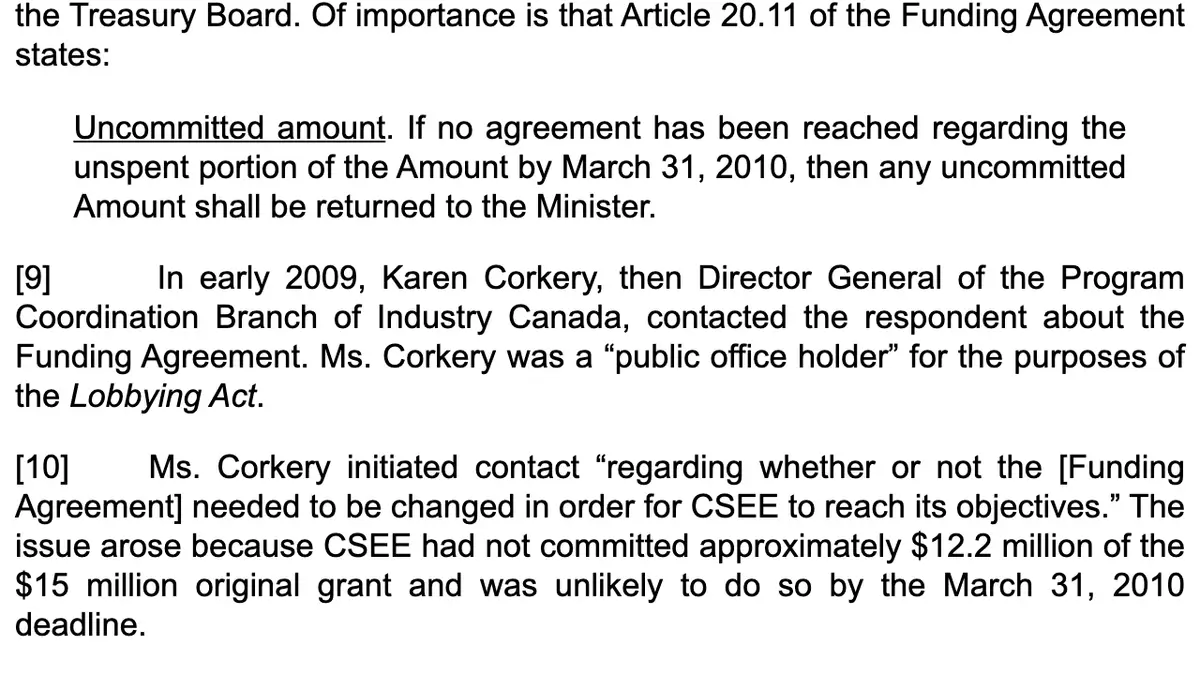
- On 6 January 2009 the Natural Resources Department received an email from him "seeking funding for an initiative backed by his other employer, the school". “the Natural Resources Department received an e-mail from Mr. Carson on Jan. 6, seeking funding for an initiative backed by his other employer, the school”The Globe and Mail, Giorno's letters to Ethics Commissioner Mary Dawson (2011-04-20) ↗
3 more receipts, 18 to 20
- His side, as Giorno's letter gave it: the email was drafted before he returned to the office, "but apparently was mistakenly not sent until after his return". “the email was drafted before he had returned to the Prime Minister's Office but apparently was mistakenly not sent until after his return”The Globe and Mail, Giorno's letters to Ethics Commissioner Mary Dawson (2011-04-20) ↗
- The school recalled the email. “The school recalled the e-mail.”The Globe and Mail, Giorno's letters to Ethics Commissioner Mary Dawson (2011-04-20) ↗
- Giorno's side: at the budget meetings he attended, nothing to do with the school came up. “no matters related to his work at the school were raised.”The Globe and Mail, Giorno's letters to Ethics Commissioner Mary Dawson (2011-04-20) ↗
- The letters stayed private until the Prime Minister's Office released them on 20 April 2011. “The letters, released by the Prime Minister's Office on Wednesday night”The Globe and Mail, the letters (2011-04-20) ↗
On 13 January 2009 Harper's chief of staff set a screen around the school and the university and kept him out of the budget. The letters that record it stayed private until April 2011.
The deal
- The year after he left the post, he negotiated an agreement with H2O, a company selling point-of-use water treatment systems. “The year following his departure from this position, he negotiated an agreement with H2O”Supreme Court of Canada, para. 9 (2018-03-23) ↗
9 more receipts, 23 to 31
- Commissions would go to his then girlfriend on every sale to First Nations, whether the First Nation or the Government of Canada paid. “regardless of whether the First Nations or the Government of Canada paid for the systems”Supreme Court of Canada, para. 9 (2018-03-23) ↗
- He demanded the commission in exchange for promising to use his government contacts. “The appellant demanded this commission in exchange for promising to use his government contacts to help H2O sell its products to First Nations.”Supreme Court of Canada, para. 9 (2018-03-23) ↗
- He then contacted First Nations leaders, officials at Indian and Northern Affairs Canada, and cabinet ministers and their staff about H2O's products. “Mr. Carson communicated with First Nations leaders, government officials at INAC, and cabinet ministers and their staff regarding H2O’s products.”Supreme Court of Canada, para. 10 (2018-03-23) ↗
- The department advised him that it funded First Nations in ways that could pay for point-of-use water systems. “INAC advised him that it provided funding to First Nations that could be used towards purchasing point-of-use water systems.”Supreme Court of Canada, para. 10 (2018-03-23) ↗
- First Nations decided how to spend that funding. “However, First Nations had full autonomy in determining how to allocate this funding.”Supreme Court of Canada, para. 10 (2018-03-23) ↗
- The department sometimes participated in and funded pilot projects for water treatment systems. “That said, INAC sometimes participated in and funded pilot projects for water treatment systems.”Supreme Court of Canada, para. 10 (2018-03-23) ↗
- He tried to get the department to fund the purchase of H2O's products as a pilot in First Nations communities. “Mr. Carson sought to convince INAC to set up a project whereby it would fund the purchase of H2O’s products”Supreme Court of Canada, para. 10 (2018-03-23) ↗
- The Court of Appeal names the company H2O Professionals Inc. “In 2010, he negotiated a contract with H2O Professionals Inc. (H2O)”Court of Appeal for Ontario, para. 2 (2017-02-17) ↗
- Justice Simmons described what it sold: point-of-use water treatment systems and water softener systems. “a company that marketed and sold point-of-use water treatment systems and water softener systems”Court of Appeal for Ontario, para. 64, Simmons J.A., dissenting (2017-02-17) ↗
A commission to his then girlfriend, the Government of Canada named as a possible payer, and a push for the department to fund the product.
What he told them
- On 6 August 2010 he emailed H2O's owners that he had spoken with the Prime Minister the night before. That is his claim in an email; the court made no finding that the call took place. “I spoke with the PM last nite and with Atleo- the movement of John Duncan to INAC does not slow anything down”Ontario Superior Court of Justice, para. 27(a), his email of 6 August 2010 (2015-11-17) ↗
“the govt has decided to fund the systems”
- Department officials met him and H2O in September and December 2010, and told them point-of-use systems would be bought by First Nations communities. “would be purchased by First Nations communities”Ontario Superior Court of Justice, para. 27(c), (e), (h) and (k) (2015-11-17) ↗
6 more receipts, 34 to 39
- On 16 September 2010 he wrote to the Assembly of First Nations' chief executive that the government had decided to fund the systems. “the govt has decided to fund the systems”Ontario Superior Court of Justice, para. 27, his email of 16 September 2010 (2015-11-17) ↗
- The AFN's side: its water specialist told him it endorsed no product. “AFN does not endorse any product nor accept any liability on the performance of the product marketed by H2O.”Ontario Superior Court of Justice, para. 27(j) (2015-11-17) ↗
- He asked H2O to buy a table at the AFN's Christmas dinner. The money was paid to him, and he gave it to his then girlfriend. The AFN was never paid. “The $5,000.00 was paid to Mr. Carson, who gave the money to [his then girlfriend]. The AFN was never paid.”Ontario Superior Court of Justice, para. 27(l) (2015-11-17) ↗
- In May 2011 the Canadian Press reported that his aides had met Carson in January; his spokeswoman, Michelle Yao, said: "All I can tell you is that they met him once, and nothing was untowards." “All I can tell you is that they met him once, and nothing was untowards”The Canadian Press, via the Red Deer Advocate (secondary), Duncan's spokeswoman, Michelle Yao (2011-05-05) ↗
- The trial judge found that between January and March 2011 he met John Duncan, then Minister of Indian and Northern Affairs, and Peter Kent. “Between January 2011 and March 2011, Mr. Carson met with then Cabinet Minister John Duncan, Minister of INAC and then Cabinet Minister Peter Kent”Ontario Superior Court of Justice, para. 27(m) (2015-11-17) ↗
- Kent was then Minister of the Environment, and the meetings, with their staff, were to discuss how H2O's systems could be funded. Neither the trial reasons, 2017 ONCA 142, 2018 SCC 12 nor the Ethics Commissioner's report finds what either minister knew of the commission. “Minister of the Environment as well as their staff to discuss the means by which H2O's water treatment systems could be funded”Ontario Superior Court of Justice, para. 27(m) (2015-11-17) ↗
He told the AFN the government had decided to fund the systems; the department told him First Nations would buy them. The AFN never got the dinner money. Between January and March 2011 he met two cabinet ministers on how to fund the product.
His old office refers him
- On 22 March 2011 the Prime Minister told the House there was "nothing to indicate" that government money or a contract was implicated. “There is nothing to indicate that a government contract or government money is implicated in this affair.”House of Commons (openparliament.ca), Stephen Harper, 2:20 p.m. (2011-03-22) ↗
“those emails, along with other documents, appeared to show that Mr. Carson was trying to use his influence to have federal funding approved”
- On 12 March 2011 Harper's chief of staff, Ray Novak, wrote to the Ethics Commissioner on the Prime Minister's behalf asking for an examination of Carson's conduct. “a letter from Mr. Ray Novak, the then Chief of Staff in the Office of the Prime Minister … requesting that an examination be undertaken”Office of the Conflict of Interest and Ethics Commissioner, report p. 1, The Request (2018-06-07) ↗
- The Commissioner noted media reports that Harper had also asked the RCMP to investigate. “according to media reports, Mr. Harper had also submitted an investigation request to the Royal Canadian Mounted Police (RCMP)”Office of the Conflict of Interest and Ethics Commissioner, report p. 1, The Request (2018-06-07) ↗
- On 22 March 2011 a second request came from Dimitri Soudas, then its director of communicationsOffice of the Conflict of Interest and Ethics Commissioner, report p. 1, The Request ↗
- The ethics examination opened on 1 April 2011 and was suspended on 14 November 2011Office of the Conflict of Interest and Ethics Commissioner, report p. 4 ↗
- The Commissioner's office interviewed him on 3 May 2011Office of the Conflict of Interest and Ethics Commissioner, report p. 2, Process and Facts ↗
- On 22 March 2011 a second request came from Dimitri Soudas, then its director of communications. “On March 22, 2011, the Office received a new, more specific request from Mr. Dimitri Soudas, the then Director of Communications”Office of the Conflict of Interest and Ethics Commissioner, report p. 1, The Request (2018-06-07) ↗
7 more receipts, 44 to 50
- Soudas wrote that he had been told of Carson's email exchanges with officials at Indian and Northern Affairs. “Mr. Soudas wrote that he had been informed of Mr. Carson’s email exchanges with the departmental authorities at Indian and Northern Affairs Canada”Office of the Conflict of Interest and Ethics Commissioner, report p. 1, The Request (2018-06-07) ↗
- In his words, those emails and other documents "appeared to show that Mr. Carson was trying to use his influence to have federal funding approved". “those emails, along with other documents, appeared to show that Mr. Carson was trying to use his influence to have federal funding approved”Office of the Conflict of Interest and Ethics Commissioner, report p. 1, The Request (2018-06-07) ↗
- John Baird told the House the government had referred the matter to the RCMP, the Ethics Commissioner and the Commissioner of Lobbying. “We immediately referred the matter, not just to the RCMP and to the Ethics Commissioner but also to the Commissioner of Lobbying.”House of Commons (openparliament.ca), John Baird, 2:25 p.m. (2011-03-22) ↗
- The trial judge found there "simply was no government business". The Court of Appeal set the acquittal aside, and the Supreme Court upheld the conviction. “simply was no government business”Court of Appeal for Ontario, para. 19 (2017-02-17) ↗
- The ethics examination opened on 1 April 2011 and was suspended on 14 November 2011. “the examination that it had undertaken on April 1, 2011, and suspended on November 14, 2011”Office of the Conflict of Interest and Ethics Commissioner, report p. 4 (2018-06-07) ↗
- That day the RCMP told the Commissioner's office it was investigating his conduct under the Criminal Code. “On November 14, 2011, the Office received notice from the RCMP that it was investigating Mr. Carson’s conduct under the Criminal Code”Office of the Conflict of Interest and Ethics Commissioner, report p. 2, Process and Facts (2018-06-07) ↗
- The Commissioner's office interviewed him on 3 May 2011. “conducted an interview with him on May 3, 2011”Office of the Conflict of Interest and Ethics Commissioner, report p. 2, Process and Facts (2018-06-07) ↗
- Between April and November 2011 it also interviewed other witnesses. “Between April and November 2011, the Office requested and obtained documents from various sources, and conducted eight interviews with other witnesses”Office of the Conflict of Interest and Ethics Commissioner, report p. 2, Process and Facts (2018-06-07) ↗
- Commissioner Mario Dion closed the examination in June 2018 without a finding, after the guilty verdict. “it is in the public interest to discontinue this examination … especially given the guilty verdict”Office of the Conflict of Interest and Ethics Commissioner, report p. 5, signed 7 June 2018 (2018-06-07) ↗
His old office asked for the ethics examination itself, and its ministers said they had sent the matter to the RCMP. The trial judge acquitted him; the higher courts reversed her. The examination never reached a finding.
The courts
- He was charged with a fraud against the government under section 121(1)(d) of the Criminal Code, influence peddling. “Mr. Carson was charged with a fraud against the government contrary to s. 121(1)(d) of the Criminal Code.”Supreme Court of Canada, paras. 3 and 11 (2018-03-23) ↗
“At trial, Mr. Carson admitted he was a person who had influence with the government”
- At trial he admitted he was a person with influence with the government. “At trial, Mr. Carson admitted he was a person who had influence with the government”Supreme Court of Canada, para. 12 (2018-03-23) ↗
10 more receipts, 55 to 64
- He also admitted he demanded a benefit for his then girlfriend in exchange for using his government contacts for H2O. “that he demanded a benefit for [his then girlfriend] as consideration for his assistance in utilizing his government contacts on behalf of H2O”Supreme Court of Canada, para. 45, quoting the trial reasons (2018-03-23) ↗
- The trial judge found First Nations could buy such systems with the department's funding without its approval. “INAC’s funding structure enabled First Nations communities to independently procure point-of-use water treatment systems, such as those sold by H2O, without INAC’s approval”Supreme Court of Canada, para. 14 (2018-03-23) ↗
- The trial judge, Justice Warkentin of the Ontario Superior Court, agreed with him on that point and acquitted him in 2015. “The trial judge, Warkentin J., agreed with Mr. Carson on this point and acquitted him.”Supreme Court of Canada, para. 12, citing 2015 ONSC 7127 (2018-03-23) ↗
- The Court of Appeal allowed the Crown's appeal, entered a verdict of guilty on 17 February 2017 and sent the case back for sentencing. “enter a verdict of guilty, and remit the matter to the trial judge for sentencing”Court of Appeal for Ontario, para. 53 (2017-02-17) ↗
- Justice Simmons dissented. She found no error of law in the acquittal and would have dismissed the Crown's appeal. “I do not agree that the trial judge misinterpreted s. 121(1)(d) or that she made any other error of law.”Court of Appeal for Ontario, paras. 60 and 61, Simmons J.A., dissenting (2017-02-17) ↗
- The Supreme Court's test: business relates to the government if it depends on, or could be facilitated by, the government. “a matter of business relates to the government if it depends on or could be facilitated by the government, given its mandate.”Supreme Court of Canada, para. 5 (2018-03-23) ↗
- The Supreme Court dismissed his appeal on 23 March 2018: he undermined the appearance of government integrity. “Mr. Carson undermined the appearance of government integrity. This is exactly the type of conduct s. 121(1)(d)(i) is intended to prohibit.”Supreme Court of Canada, paras. 7 and 8 (2018-03-23) ↗
- The Supreme Court dismissed his appeal, with Justice Côté dissenting. “Held (Côté J. dissenting): The appeal should be dismissed.”Supreme Court of Canada, head note; Present: McLachlin C.J. and Abella, Moldaver, Karakatsanis, Wagner, Gascon, Côté, Brown and Rowe JJ. (2018-03-23) ↗
- Justice Karakatsanis, for the majority, found the department could have facilitated the purchases by changing its funding terms and conditions to H2O's benefit. “INAC could have facilitated these purchases, for example, by changing its funding terms and conditions to H2O’s benefit”Supreme Court of Canada, para. 6, Karakatsanis J. (2018-03-23) ↗
- She found he tried to convince the government to create a pilot project to promote H2O's products. “Mr. Carson tried to convince the government to create a pilot project to promote H2O’s products”Supreme Court of Canada, para. 6, Karakatsanis J. (2018-03-23) ↗
He admitted the deal. The courts split only on whether the law reached it, and the Supreme Court held that it does.
The second conviction: lobbying during his ban
- Leaving the Prime Minister's employ put him under the Lobbying Act's five-year ban, from 4 February 2009 to 4 February 2014. “This prohibition commenced on February 4, 2009 and extended to February 4, 2014.”Court of Appeal for Ontario, para. 4 (2019-05-15) ↗
2 more receipts, 66 to 67
- The school had a $15.0M grant from Industry Canada under an agreement of 7 March 2007, made while he was still in the Prime Minister's Office. The court found he had no part in that award. “still a senior advisor at the Prime Minister's office at that point, and was not involved in the initial award of the grant”Court of Appeal for Ontario, para. 7 (2019-05-15) ↗
- The school could, in consultation with the Minister, decide the best use of money not committed by that date. “the CSEE could, in consultation with the Minister, determine the best use of any funds not committed by that date”Court of Appeal for Ontario, para. 8 (2019-05-15) ↗
- If no agreement on the unspent money was reached by 31 March 2010, the agreement returned the uncommitted part to the Minister. “If no agreement has been reached regarding the unspent portion of the Amount by March 31, 2010, then any uncommitted Amount shall be returned”Court of Appeal for Ontario, para. 8, Article 20.11 of the Funding Agreement (2019-05-15) ↗
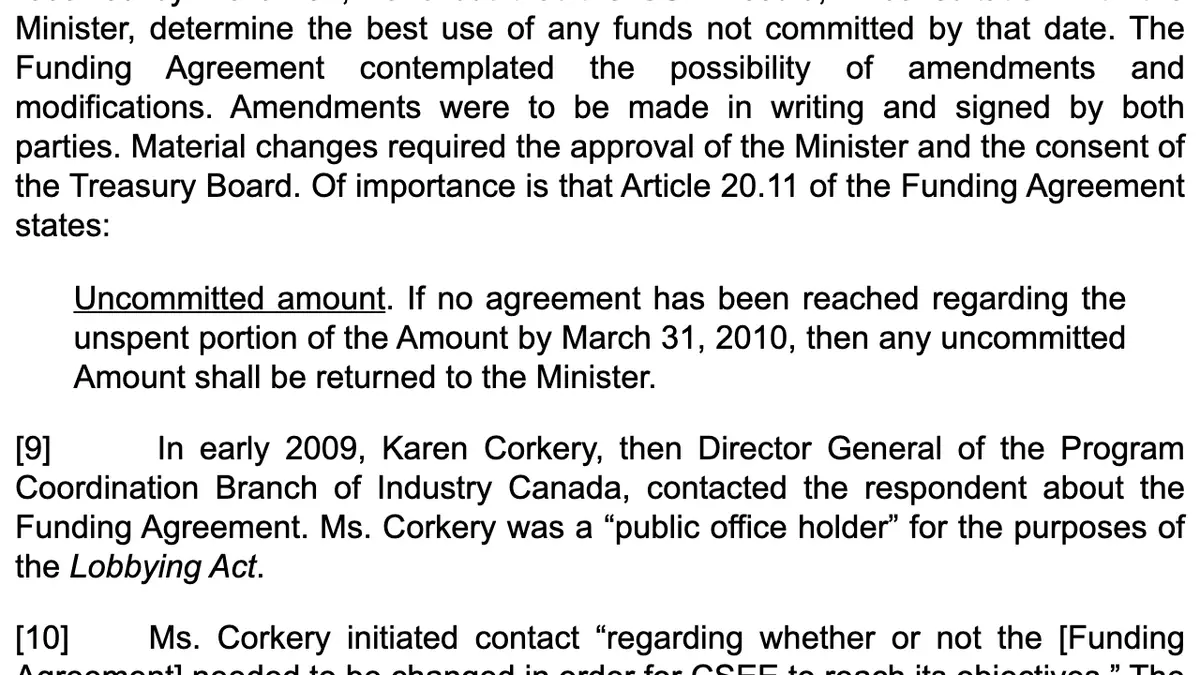
- In early 2009 an Industry Canada director general contacted him about the funding agreement. “In early 2009, Karen Corkery, then Director General of the Program Coordination Branch of Industry Canada, contacted the respondent about the Funding Agreement.”Court of Appeal for Ontario, para. 9 (2019-05-15) ↗
3 more receipts, 70 to 72
- About $12.2M of the grant was uncommitted, and unlikely to be committed in time. “CSEE had not committed approximately $12.2 million of the $15 million original grant and was unlikely to do so by the March 31, 2010 deadline”Court of Appeal for Ontario, paras. 9 and 10 (2019-05-15) ↗
- Communications with officials about possible amendments followed, not all of them initiated by him. “about possible amendments to the Funding Agreement. Not all these communications were initiated by the respondent.”Court of Appeal for Ontario, para. 11 (2019-05-15) ↗
- On 13 January 2010 he and the director general signed an amending agreement. “On January 13, 2010, Ms. Corkery and the respondent signed an amending agreement.”Court of Appeal for Ontario, para. 12 (2019-05-15) ↗
- It set 31 March 2014 as the date to commit the rest of the grant. “the CSEE would commit the remainder of the previously granted funds by March 31, 2014”Court of Appeal for Ontario, paras. 11 and 12 (2019-05-15) ↗
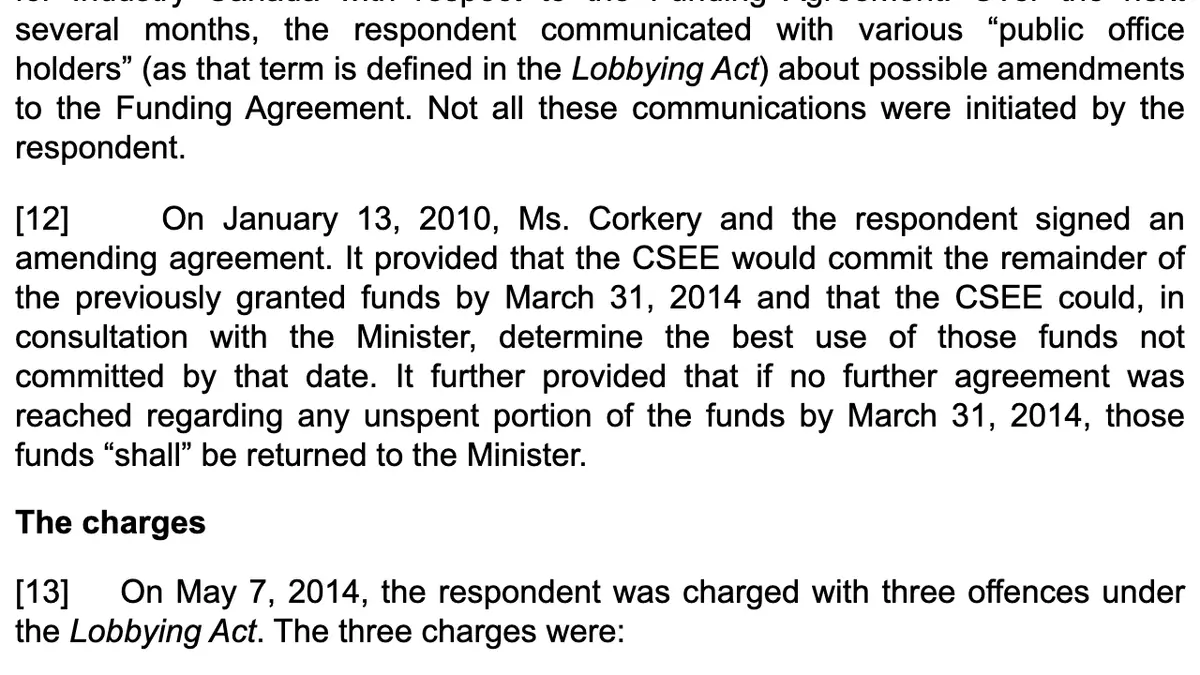
- On 7 May 2014 he was charged with three offences under the Lobbying Act. “On May 7, 2014, the respondent was charged with three offences under the Lobbying Act.”Court of Appeal for Ontario, para. 13 (2019-05-15) ↗
4 more receipts, 75 to 78
- The first: undertaking, for payment, to communicate with officials on behalf of the Energy Policy Institute of Canada. “did, for payment, undertake to communicate with public officer holders on behalf of the Energy Policy Institute of Canada”Court of Appeal for Ontario, para. 13 (2019-05-15) ↗
- The second: arranging, for payment, a meeting between officials and the institute's members. “did, for payment, arrange a meeting between public office holders and members of the Energy Policy Institute of Canada”Court of Appeal for Ontario, para. 13 (2019-05-15) ↗
- On 16 September 2016 the trial judge convicted him on all three. “On September 16, 2016, the respondent was convicted of all three charges by the trial judge”Court of Appeal for Ontario, para. 14 (2019-05-15) ↗
- The trial judge was Justice Catherine Kehoe of the Ontario Court of Justice. “the convictions entered by Justice Catherine Kehoe of the Ontario Court of Justice”Court of Appeal for Ontario, heading (2019-05-15) ↗
- She sentenced him on 4 November 2016. “the sentence imposed on November 4, 2016”Court of Appeal for Ontario, heading (2019-05-15) ↗
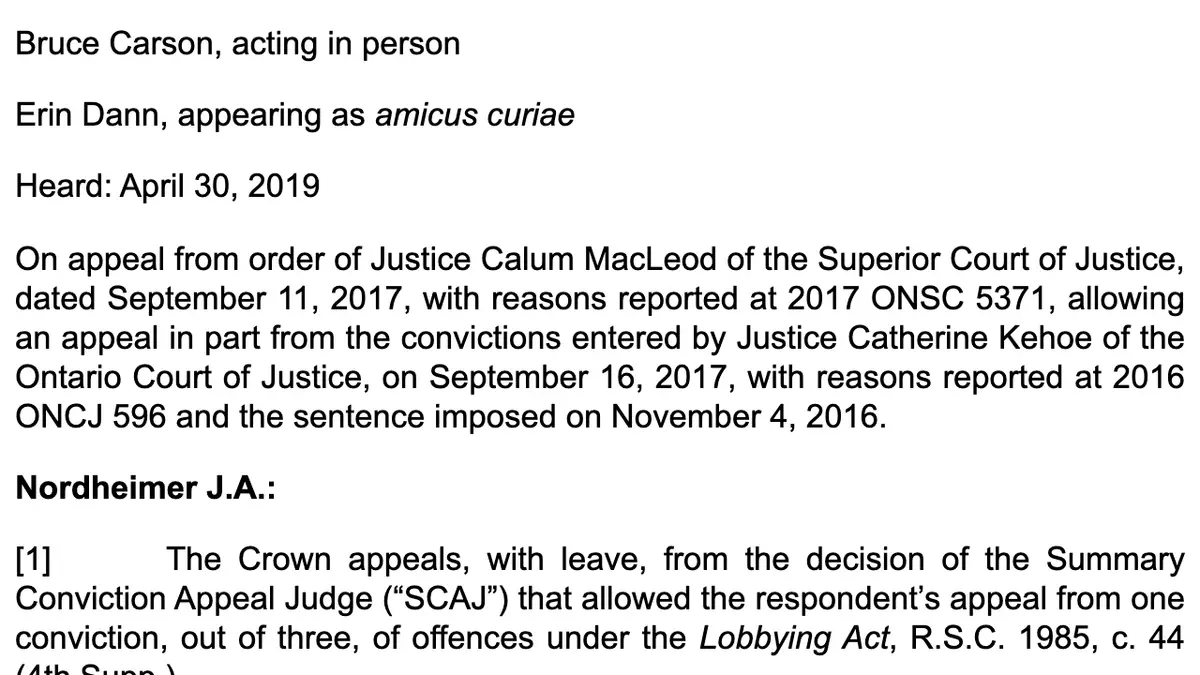
- Her fines: $35,000 on the first count, $10,000 on the second and $5,000 on the third, $50,000 in all. “a fine of $35,000 on count #1; $10,000 on count #2; and $5,000 on count #3”Court of Appeal for Ontario, para. 14 (2019-05-15) ↗
2 more receipts, 81 to 82
- The trial judge found that, as a result of his communications with Industry Canada, the uncommitted money did not have to be returned to the Minister. “with the ultimate result that the uncommitted of amount of $12.2 million did not have to be returned to the Minister”Court of Appeal for Ontario, para. 15 (2019-05-15) ↗
- She found the uncommitted money would have been forfeited without his communications and meetings with Industry Canada. “would have been forfeited had the communications and meetings between the respondent and the public officer holders at Industry Canada not taken place”Court of Appeal for Ontario, para. 16 (2019-05-15) ↗
- The appeal judge was Justice Calum MacLeod of the Superior Court of Justice, who ruled on 11 September 2017. “On appeal from order of Justice Calum MacLeod of the Superior Court of Justice, dated September 11, 2017”Court of Appeal for Ontario, heading (2019-05-15) ↗
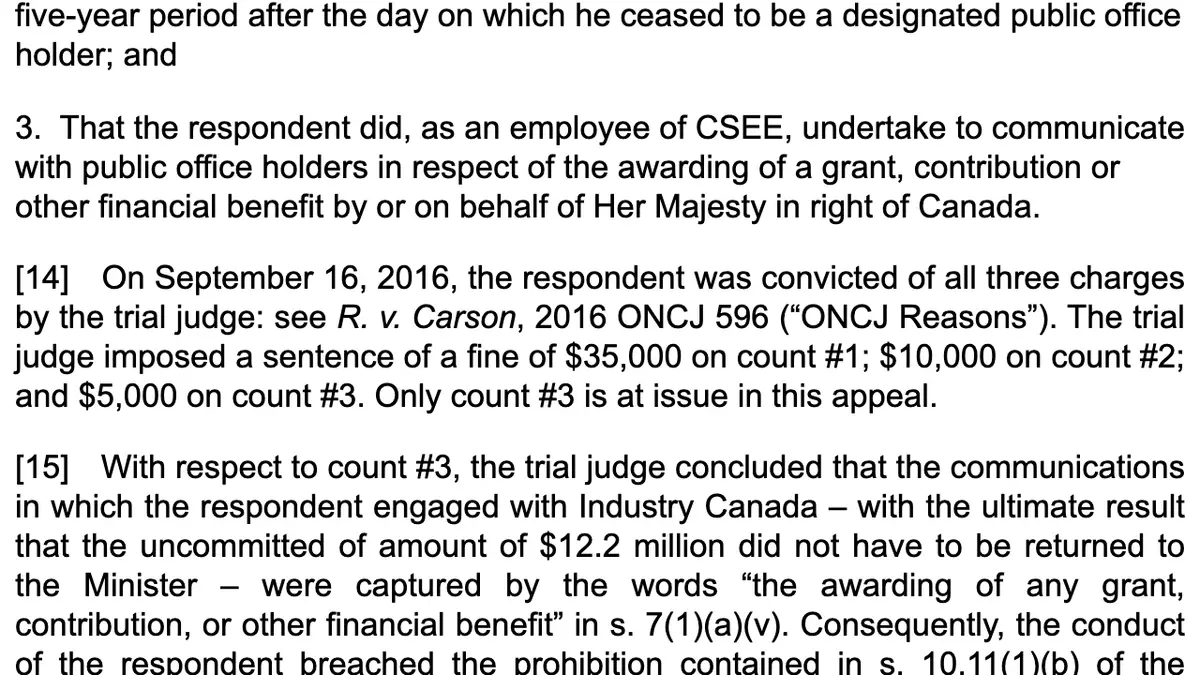
- The appeal judge's reasoning in 2017: answering officials' questions about a grant already awarded was not clearly lobbying on the award of one. He set aside the grant count. “Responding to inquiries from government officials regarding a grant that had already been awarded … is not clearly engaging in”Court of Appeal for Ontario, para. 18, quoting 2017 ONSC 5371 at para. 24 (2019-05-15) ↗
2 more receipts, 85 to 86
- The Court of Appeal reinstated the grant count and its fine on 15 May 2019: who started the conversation does not matter. “A person may carry on a communication whether the person is the instigator of the conversation or the recipient of it.”Court of Appeal for Ontario, paras. 20 and 26 (2019-05-15) ↗
- The extension, the court held, was a financial benefit as much as the initial award of the grant. “That result constituted the award of a financial benefit every bit as much as the initial award of the funds did.”Court of Appeal for Ontario, para. 24 (2019-05-15) ↗
A second conviction, under the Lobbying Act. The trial judge found that, as a result of his communications, about $12.2M of a federal grant to the school he ran "did not have to be returned to the Minister". During his ban he undertook, for payment, to communicate with officials for the Energy Policy Institute of Canada.
- Published.
- Added the record's own pages beside the text, cropped to the quoted words and marked.
- Set key quotes as pull quotes and folded long lists behind their count.
- The official's page now shows this story's opening, with a link here.