Story · 2026-10-15
He kept his own cheque off his return to stay under the limit
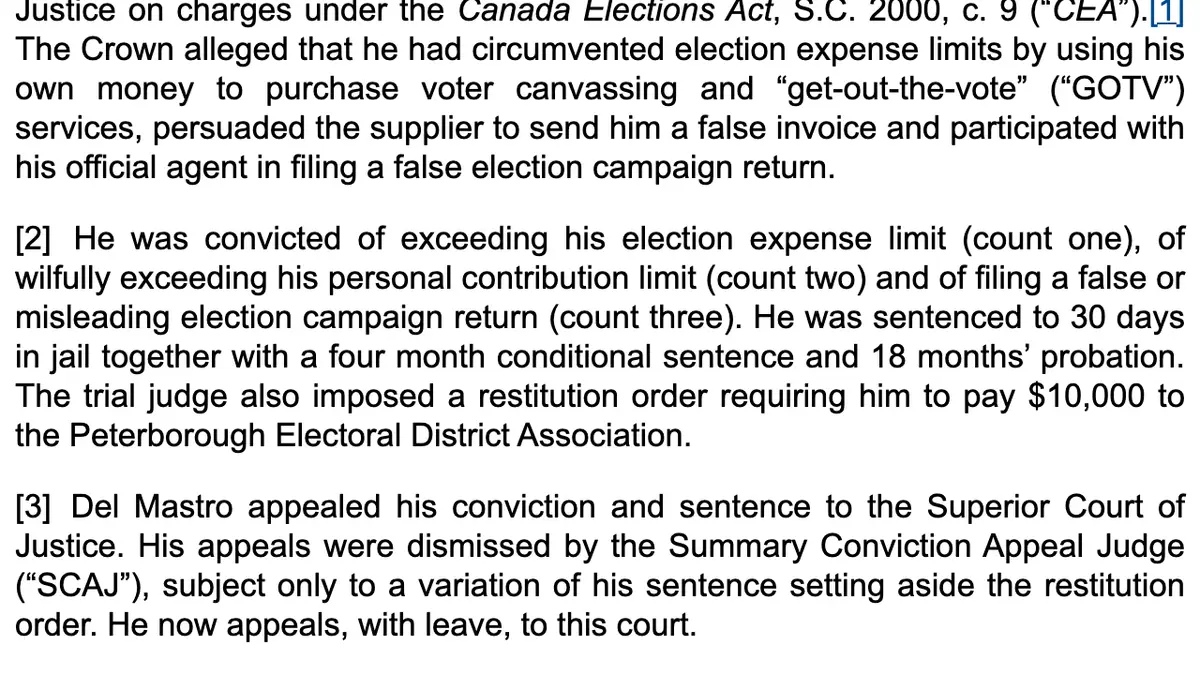
Guilty at trial in 2014, upheld on appeal twice, and the Supreme Court refused to hear him in 2018.
In the 2008 election, Conservative MP Dean Del Mastro paid $21,000 from his own account for voter calls. His return did not report it, and listed expenses of $91,770 against a limit of $92,566. Elections Canada reimbursed $54,593 of his allowable election expenses from public money. From May 2011 to September 2013 he was the Prime Minister's parliamentary secretary.
Dean Del Mastro, Conservative MP for Peterborough, 2006 to 2014; parliamentary secretary to the Prime Minister, May 2011 to September 2013
In early October 2008, the firm phoning voters for Dean Del Mastro's Peterborough campaign stopped calling, at about half the contract. Its bill was unpaid. The Conservative MP promised to pay in full and wrote a cheque from his personal account for $21,000. It was back-dated to August, a date before the election writ period. The calls resumed.
The law capped two things: what the campaign could spend, $92,566 in Peterborough, and what he could personally contribute to it, $2,100. His return did not report his payment. It listed $1,575 paid to the firm and expenses of $91,770, "ostensibly just under" the limit, in the Court of Appeal's words. Elections Canada reimbursed $54,593 of his allowable election expenses from public money.
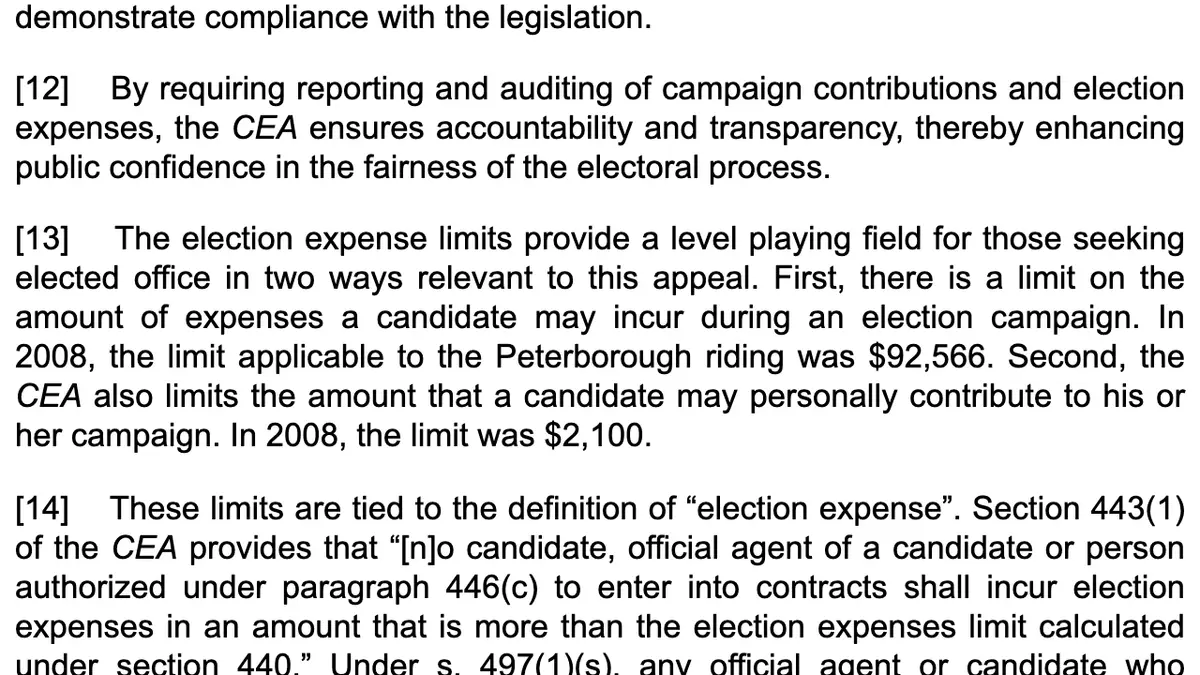
Our read: it was no slip. "The appellant's campaign knew almost immediately that paying the bill would put the appellant off-side on his expenses," the Court of Appeal found, and he "worked with" the supplier "to procure a false invoice." He signed the return's solemn declaration on 10 February 2009. From May 2011 he was the Prime Minister's parliamentary secretary. On 5 November 2014, five days after a judge found him guilty and sitting as an independent, he told the House he stood by his filings.
In June 2012, asked about the cheque in the House, the Prime Minister answered that he had "submitted all of his information to Elections Canada." In May 2013 he was reappointed the Prime Minister's parliamentary secretary. On 19 September 2013 a new slate moved him to the regional development agencies and gave the Prime Minister's post to Paul Calandra; the order gives no reason. On 26 September the Commissioner of Canada Elections charged him, and the next day an order in council ended his new post. Our read: the government kept him as the Prime Minister's parliamentary secretary after the cheque was raised in the House in June 2012, moved him down on 19 September 2013, and removed him the day after the charges. On 4 November 2014, the morning before he resigned, the government amended a bill to withdraw convicted MPs' pensions so it reached only Criminal Code offences and convictions from then on. It said that had nothing to do with him.
Our read
Our read: Dean Del Mastro went over the 2008 spending limit knowing he would, and let a return go in that left his own cheque off it. The facts under that read are not ours. A trial court found them, two appeal courts upheld the convictions, and by the end he no longer disputed them. The Court of Appeal's own words: he and his campaign team "realized early in the campaign that they would exceed his campaign limit", and he then worked with the supplier to get a false invoice.
The limits are there to provide "a level playing field for those seeking elected office", in the Court of Appeal's words. He went past one with a back-dated cheque and a false invoice, and signed the solemn declaration on the return. Elections Canada reimbursed $54,593 of his allowable election expenses. Whether any of it was ever sought back is an open question below.
In June 2012, with the cheque raised in the House, the Prime Minister answered that he had given Elections Canada all of his information, and a parliamentary secretary told the House he "has followed all of the rules." He stayed the Prime Minister's parliamentary secretary, reappointed in May 2013. On 19 September 2013 a new slate moved him to the regional development agencies and gave the Prime Minister's post to Paul Calandra, with no reason in the order; he was removed from the new post the day after the charges. On 4 November 2014, the morning before he resigned, a government amendment rewrote a pension bill to reach only a list of Criminal Code offences, and only convictions from then on. Our read: the government vouched for a return the courts later found false, kept him as the Prime Minister's parliamentary secretary after the cheque was raised in the House in June 2012, moved him down on 19 September 2013 and removed him the day after the charges, and wrote a pension rule that, on its face, could not reach him. It said the rule had nothing to do with him; no document shows otherwise, and none shows why that text was chosen.
The order matters. He signed the return in February 2009. From May 2011 to September 2013 he was the Prime Minister's parliamentary secretary. On 5 November 2014, sitting as an independent five days after the verdict, he told the House: "I stand by my filings in 2008." Is this who you want representing you?
The story
Dean Del Mastro won Peterborough for the Conservatives in 2006. In the fall of 2008 he ran again, under a campaign expense limit of $92,566 and a cap of $2,100 on what he could personally contribute to his own campaign.
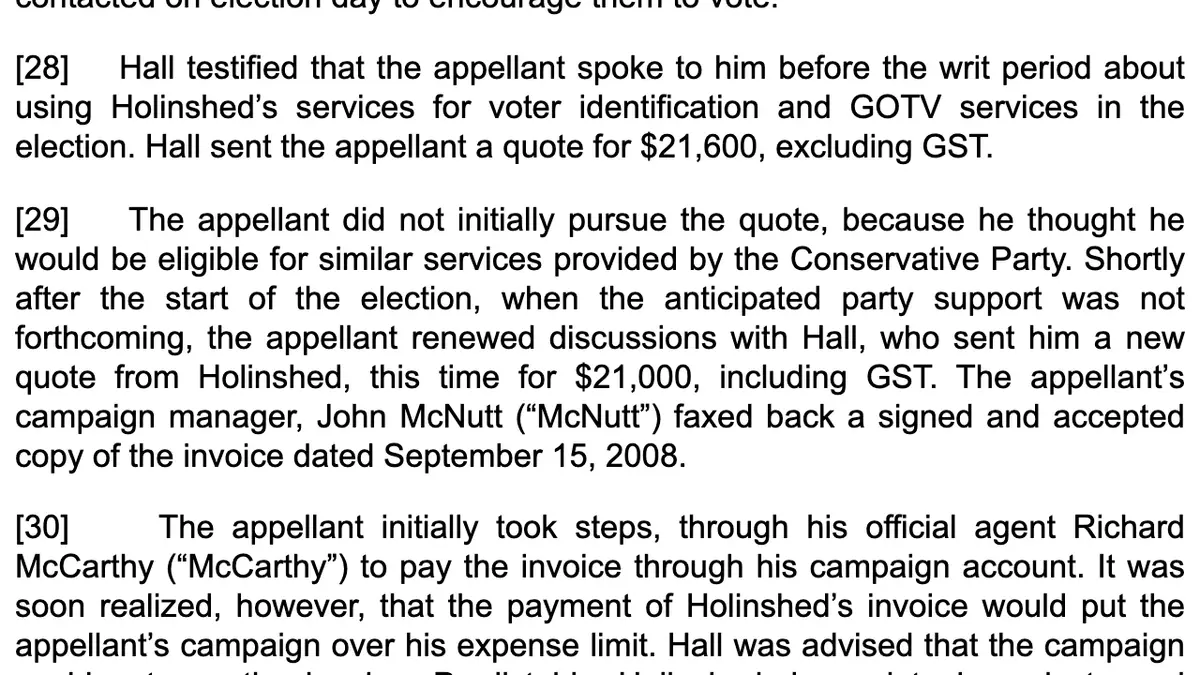
He had first passed on the supplier's quote, the Court of Appeal recorded, because he thought he would be eligible for similar services from the Conservative Party. When "the anticipated party support was not forthcoming", early in the campaign, he went back to the supplier.
On 15 September 2008 his campaign signed a contract with Holinshed Research Group for voter identification and get-out-the-vote calls, worth $21,000. On 2 October, at about half the contract, Holinshed stopped for non-payment. The trial judge found what happened next: he promised full payment, the calls resumed, and he paid from his personal account.
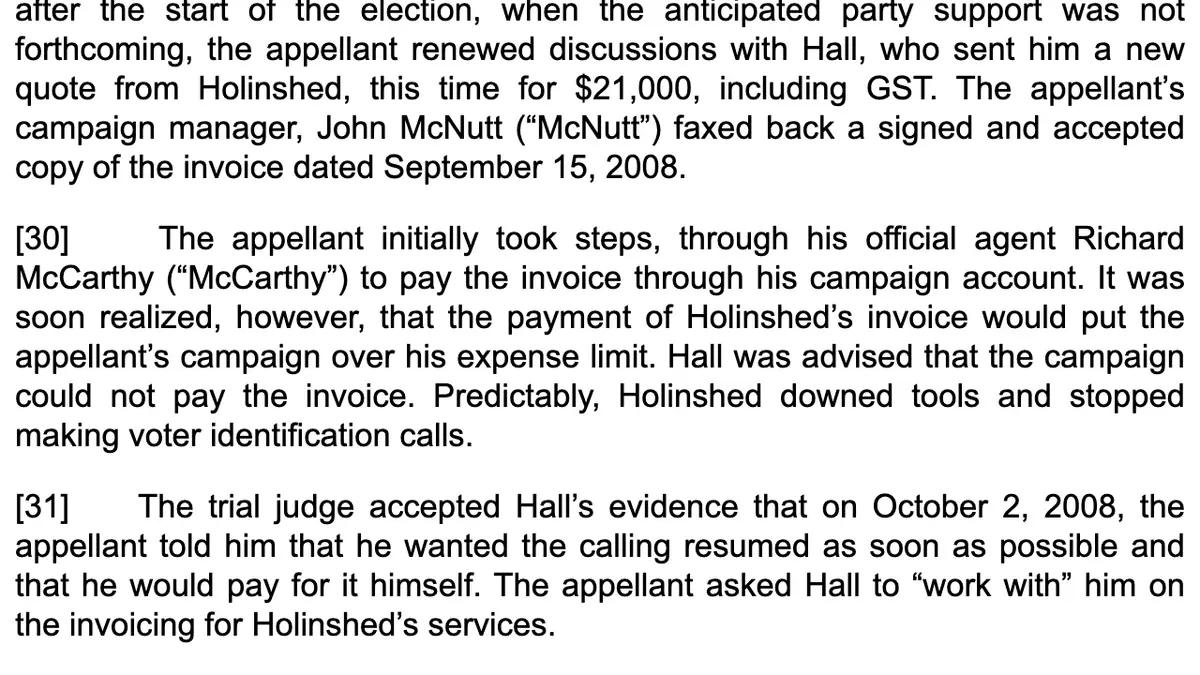
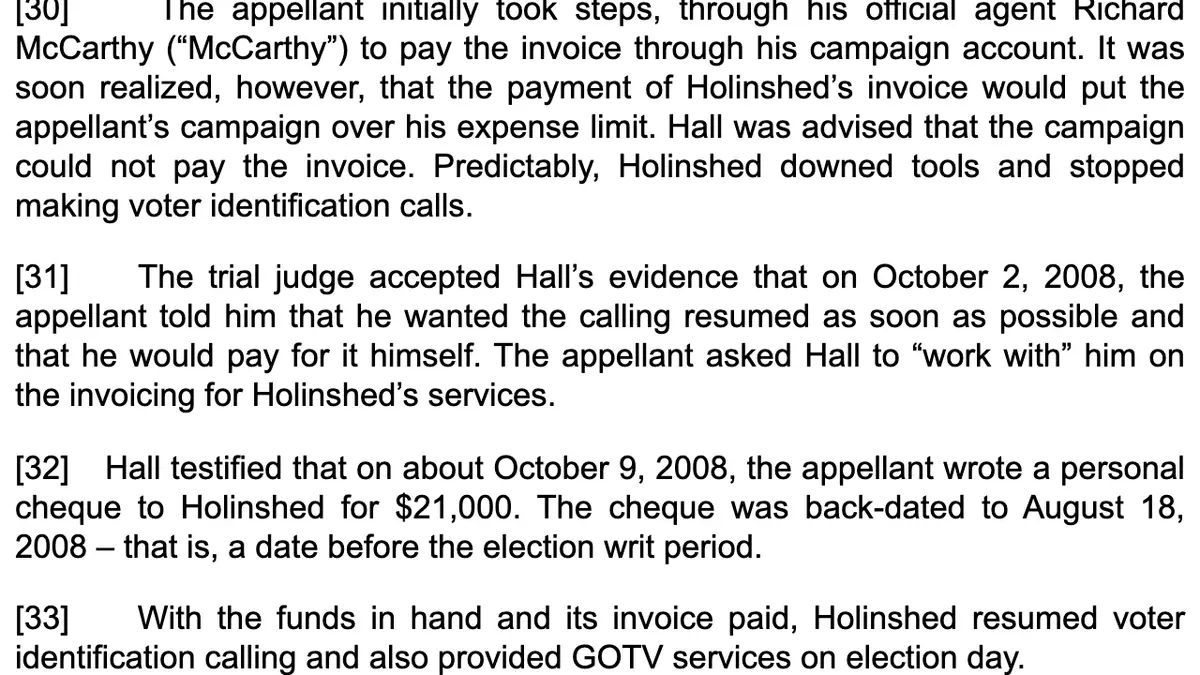
His official agent had moved to pay the bill from the campaign account. "It was soon realized, however, that the payment of Holinshed's invoice would put the appellant's campaign over his expense limit," the Court of Appeal wrote. The supplier was told the campaign could not pay, and the calls stopped. The trial judge accepted the supplier's evidence that on 2 October he said he would pay for the calling himself, and asked the supplier to "work with" him on the invoicing.
The cheque was dated 18 August 2008. The Court of Appeal found that he wrote it on about 9 October, and that it was "back-dated" to "a date before the election writ period."
The Court of Appeal named the reason he paid it himself. "The appellant and his campaign team realized early in the campaign that they would exceed his campaign limit if they incurred the Holinshed expense." And: "This was why the appellant paid the bill personally and then 'worked with' Hall to procure a false invoice." Frank Hall was Holinshed's. Our read: the money moved off the books.
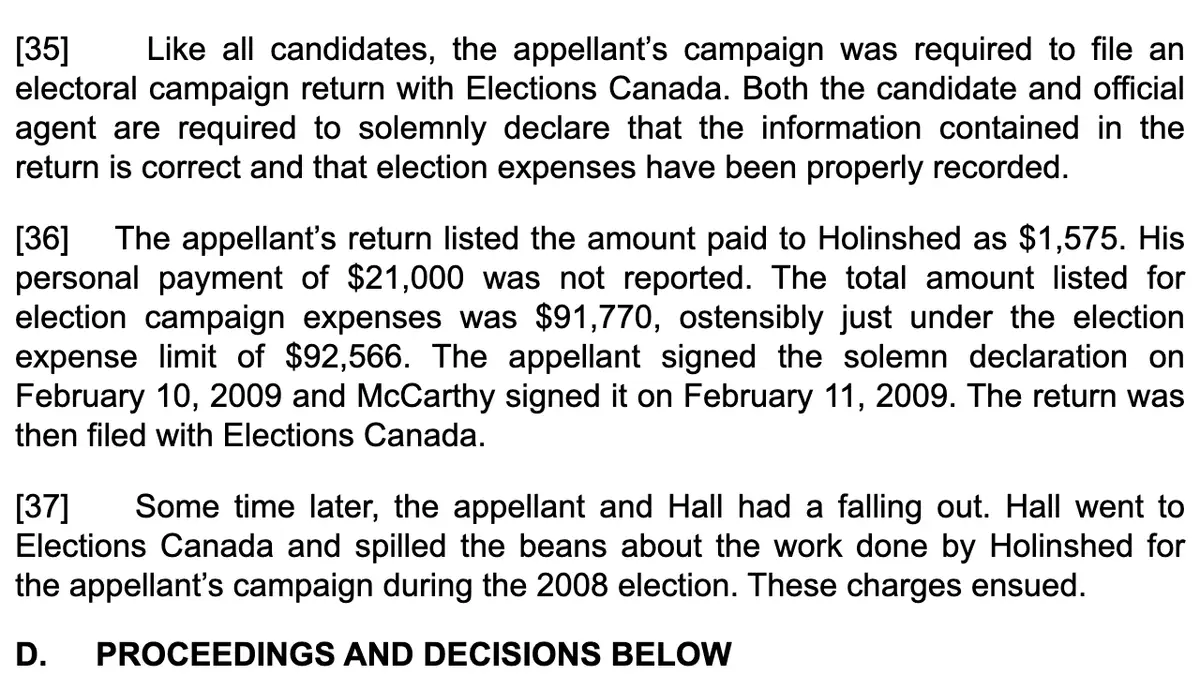
After the election came the paperwork. The trial judge found "continuing efforts to absorb some of the election expense of the Holinshed Voter ID and GOTV work into other contracts". The return his official agent, Richard McCarthy, filed listed $1,575 paid to Holinshed. His own $21,000 was not reported. Total expenses: $91,770, "ostensibly just under" the limit, in the Court of Appeal's words. He signed the solemn declaration on 10 February 2009.
The invoice behind the $1,575 came from the supplier on 12 December 2008, after the election, for "limited voter GOTV". It was dated 14 September. Our arithmetic: count his own cheque in place of it, and his expenses come to $111,195, which is $18,629 over the limit.
Elections Canada's list for the 2008 election shows $54,593 of his allowable election expenses reimbursed from public money.
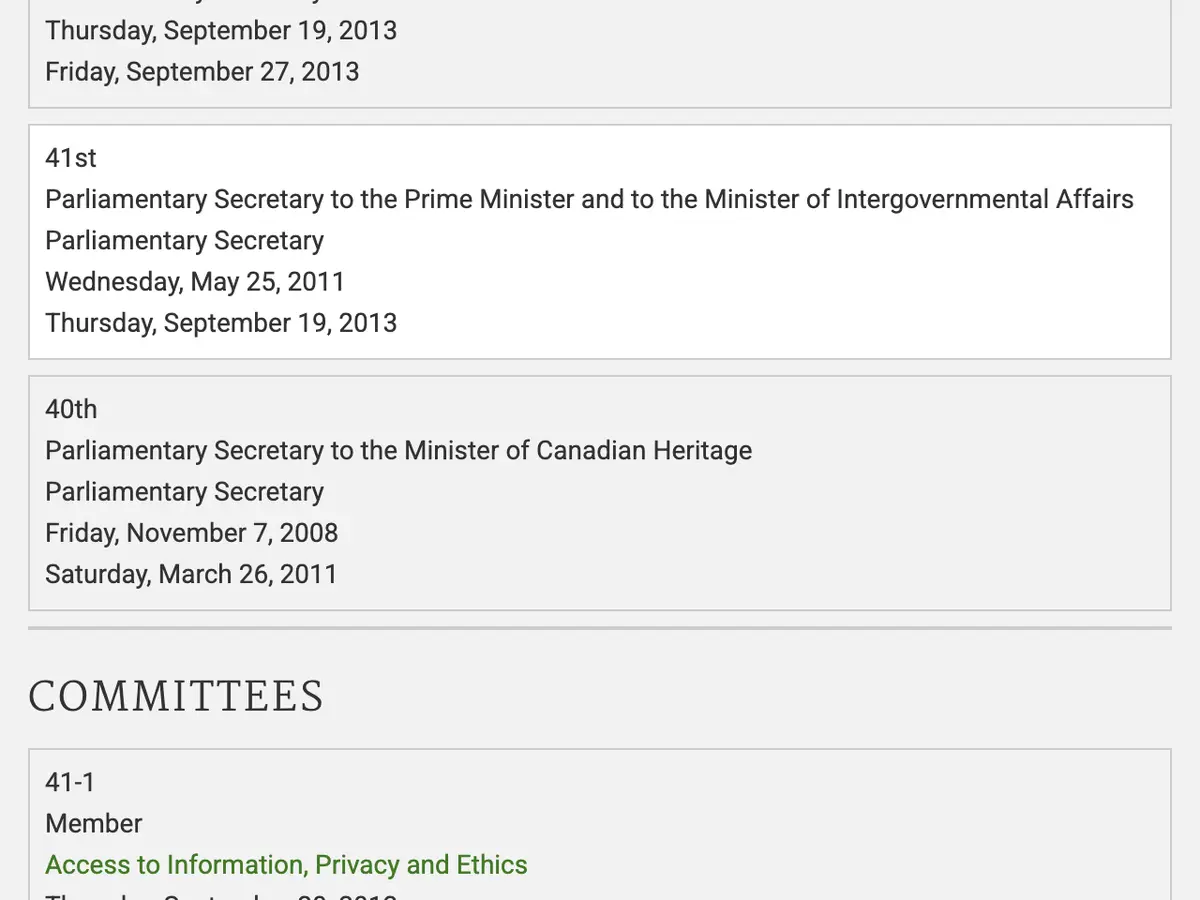
He kept rising. He was parliamentary secretary to the Minister of Canadian Heritage from November 2008 to March 2011, and to the Prime Minister from May 2011 to 19 September 2013. By 30 September 2013 he sat as an independent.
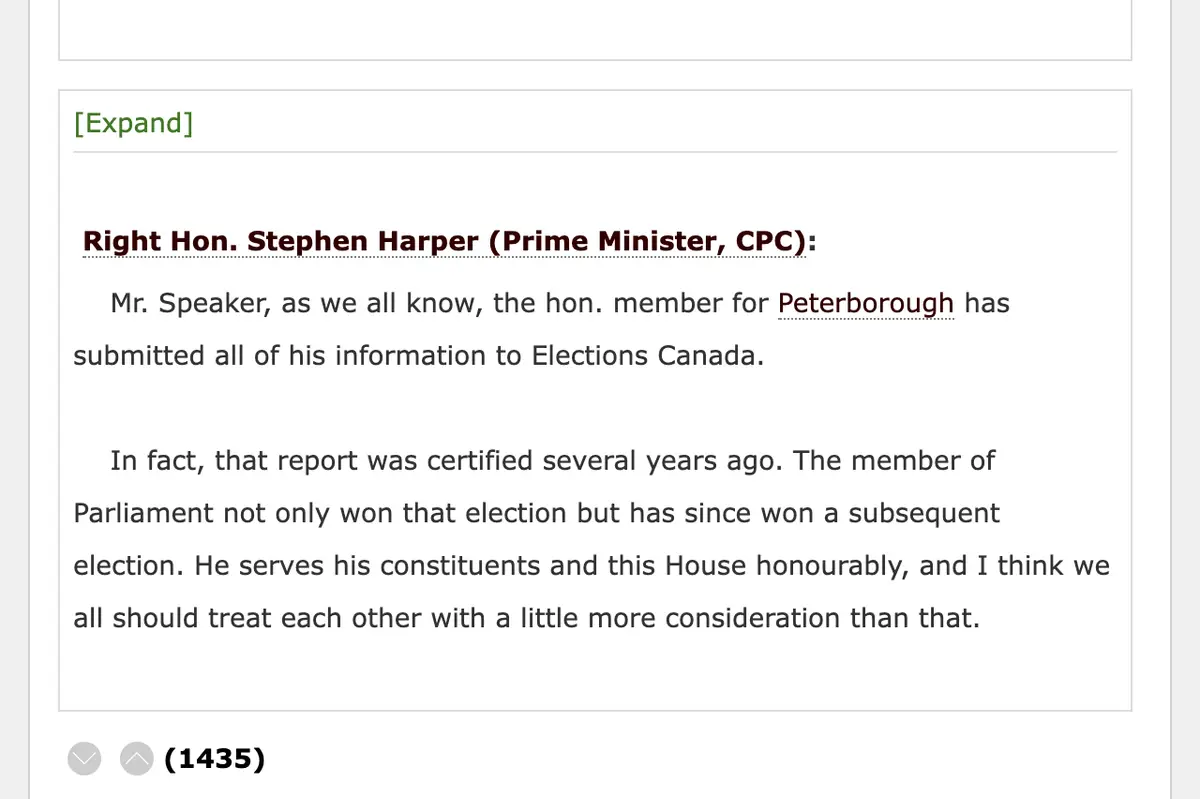
The cheque was no secret by then. On 13 June 2012 the Liberal MP Bob Rae put it to the Prime Minister in the House. Stephen Harper answered: "as we all know, the hon. member for Peterborough has submitted all of his information to Elections Canada." Pierre Poilievre, answering for the government later in the sitting: "The hon. member for Peterborough has followed all of the rules."
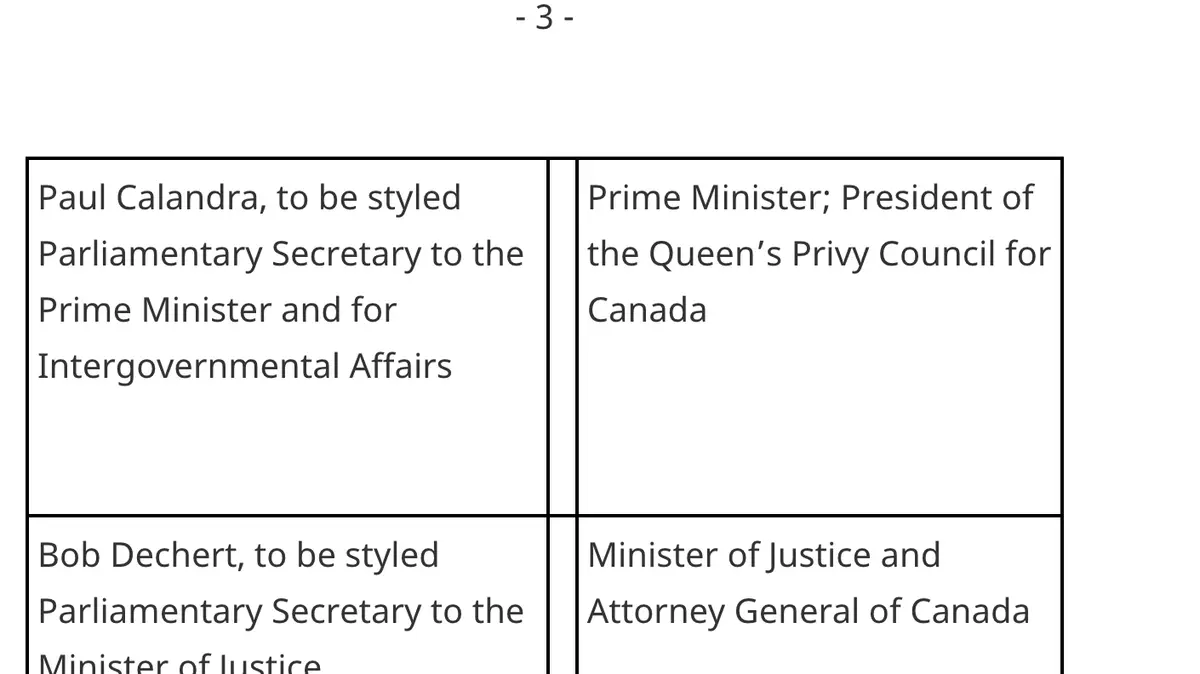
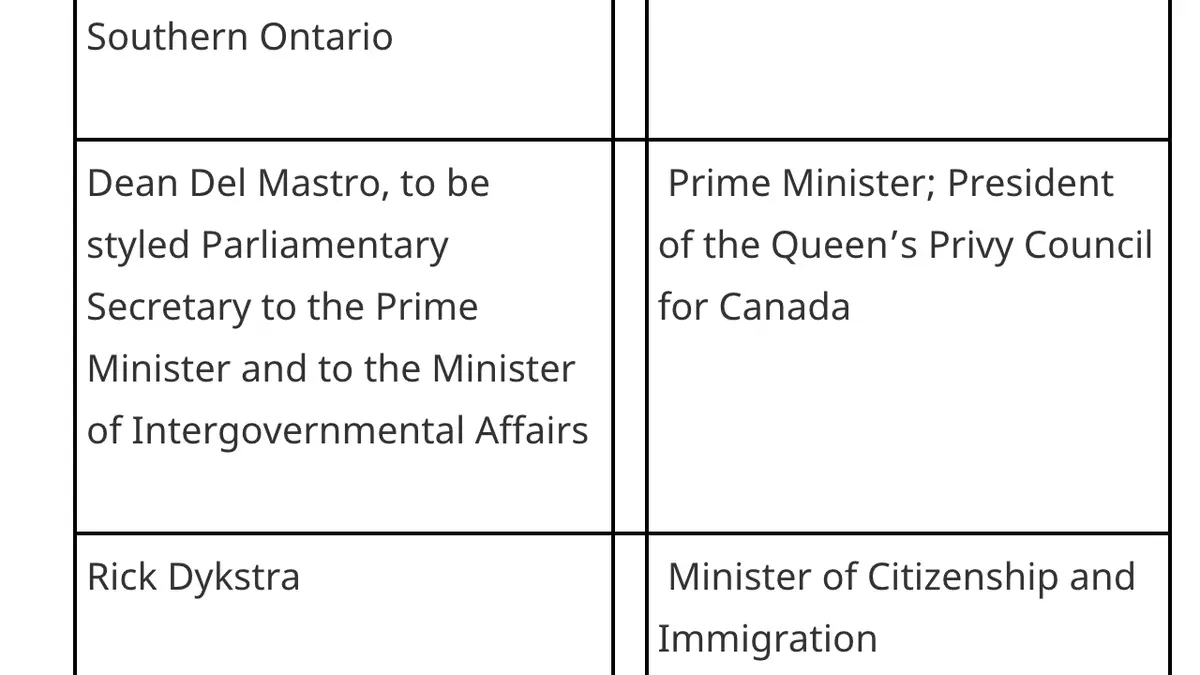
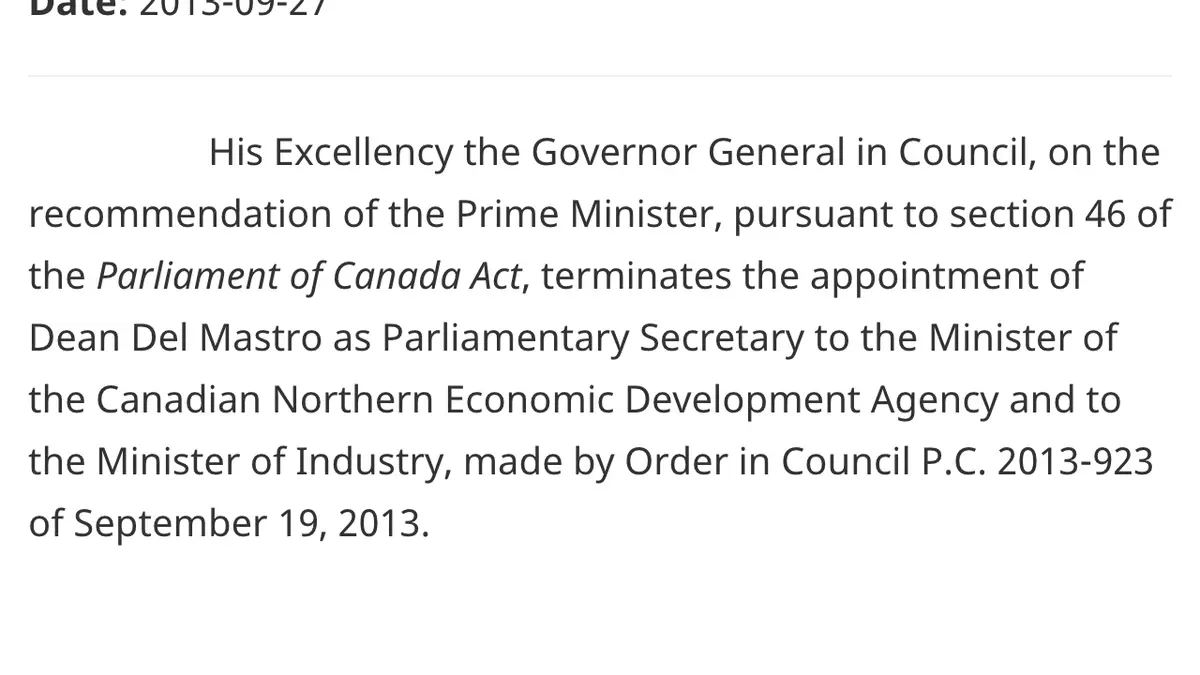
On 25 May 2013 he was reappointed the Prime Minister's parliamentary secretary. On 19 September 2013 an order in council, on the Prime Minister's recommendation, replaced the slate. It moved him to the ministers for the regional development agencies, the Canadian Northern Economic Development Agency, the federal development agency for Southern Ontario and the initiative for Northern Ontario, and gave the Prime Minister's post to Paul Calandra. The order gives no reason. On 26 September the Commissioner of Canada Elections charged him with paying $21,000 of election expenses out of his own funds, over the $2,100 cap, and charged him and his official agent, Richard McCarthy, with overspending the limit and with a return that reported $1,575 in place of the cheque. Those were charges; the findings came at trial. The next day an order in council ended his appointment.
- The calling contract is signedOntario Court of Justice, reasons for judgment, the Holinshed contract ↗
- About now: he pays it himself, back-dated to AugustCourt of Appeal for Ontario, para. 32 ↗
- He signs the return without the chequeCourt of Appeal for Ontario, para. 36 ↗
- Becomes the Prime Minister's parliamentary secretaryPrivy Council Office, the slate effective 25 May 2011 ↗
- The Prime Minister tells the House he gave Elections Canada all his informationHouse of Commons, Oral Questions, Ethics, 14:30, the Prime Minister ↗
- Reappointed the Prime Minister's parliamentary secretaryPrivy Council Office, the slate effective 25 May 2013, for a period ending on 24 May 2014 ↗
- Moved off the Prime Minister's post to the regional agenciesPrivy Council Office, the slate effective 19 September 2013, for a period ending on 18 September 2014 ↗
- Charged by the Commissioner of Canada ElectionsCommissioner of Canada Elections, Charge no. 2 ↗
- Removed from the new post, the day after the chargesPrivy Council Office, the order of 27 September 2013 ↗
- Convicted at trialOntario Court of Justice, reasons for judgment, verdict ↗
- The government rewrites the pension billHouse of Commons, Standing Committee on Procedure and House Affairs, Craig Scott, reading amendment G-1, subsection (4) ↗
- Resigns, standing by his filingsHouse of Commons, Resignation of Member, 15:15 to 15:20 ↗
- The Supreme Court will not hear himSupreme Court of Canada, docket entry, 2018-04-05 ↗
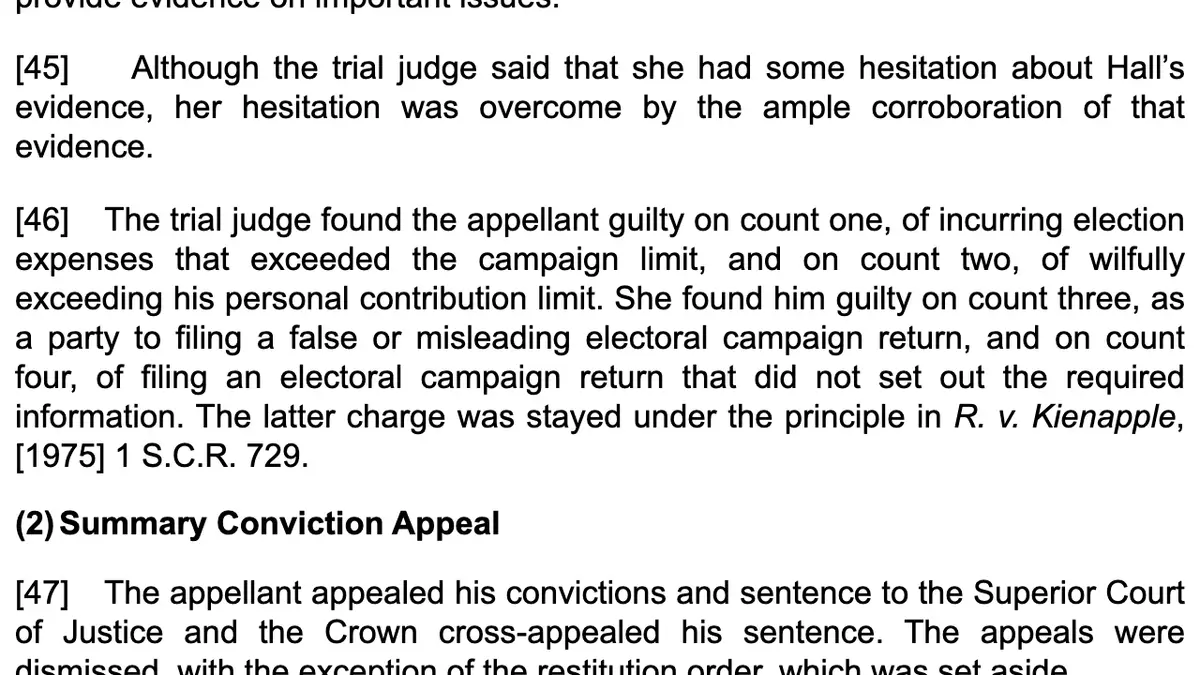
The trial judge was "led to reject Mr. Del Mastro's evidence on key issues." "At times, the way in which he testified led me to believe that he was avoiding the truth," the judge wrote, and "He frequently obfuscated the evidence." On 31 October 2014 the court found him guilty of incurring election expenses over the limit. He was also convicted of wilfully exceeding his personal contribution limit and, as a party, of "filing a false or misleading electoral campaign return", the Court of Appeal recorded.
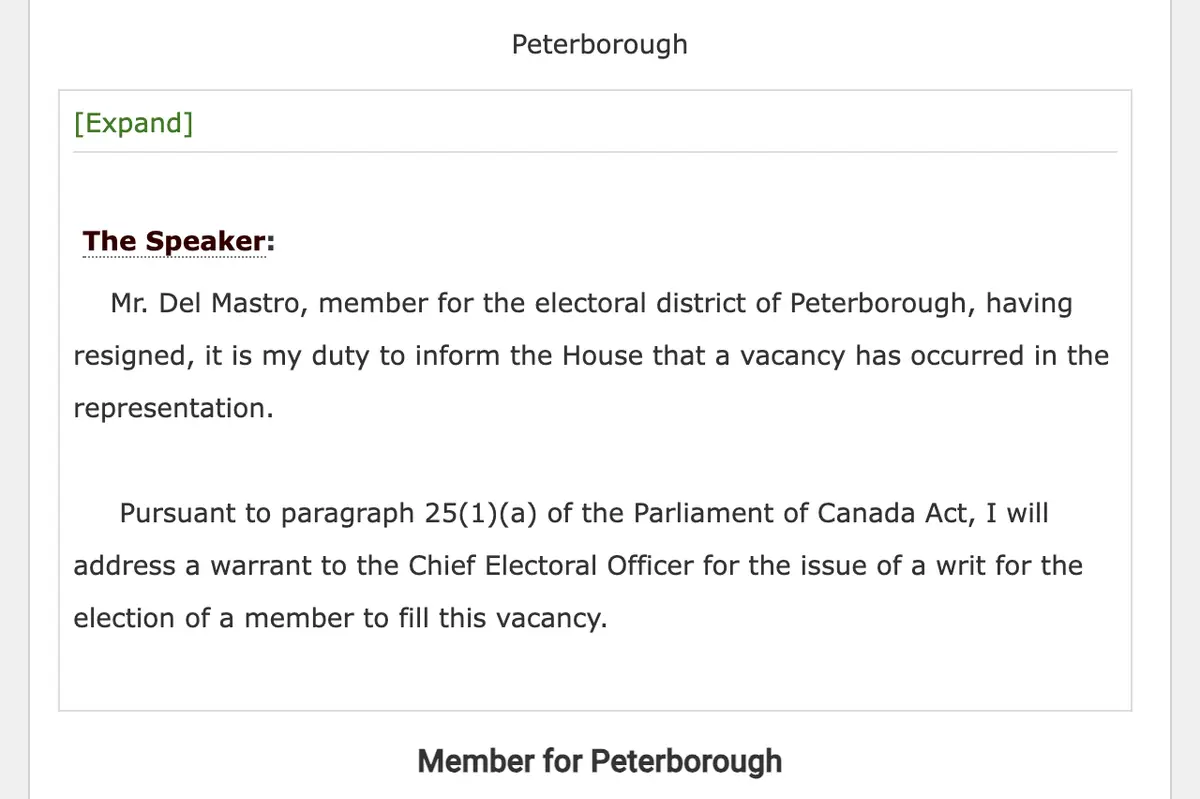
Five days later, on 5 November 2014, he spoke in the House. "I did not donate too much money to myself. I did not, and I stand by my filings in 2008." Then he resigned his seat.
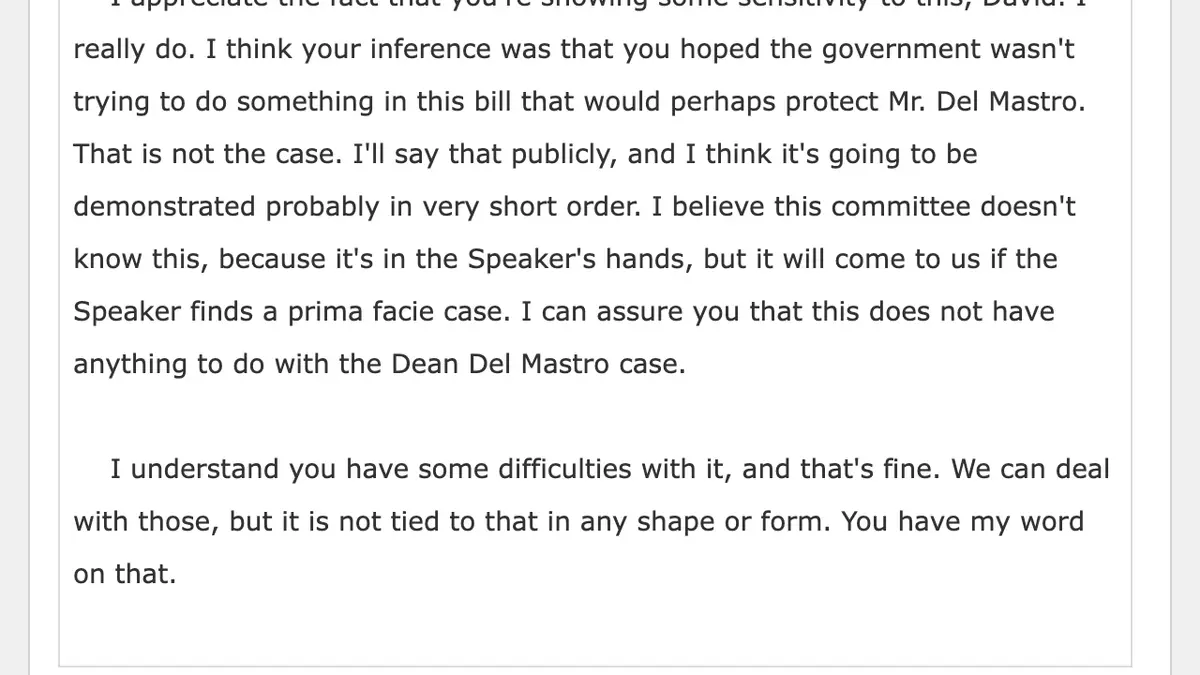
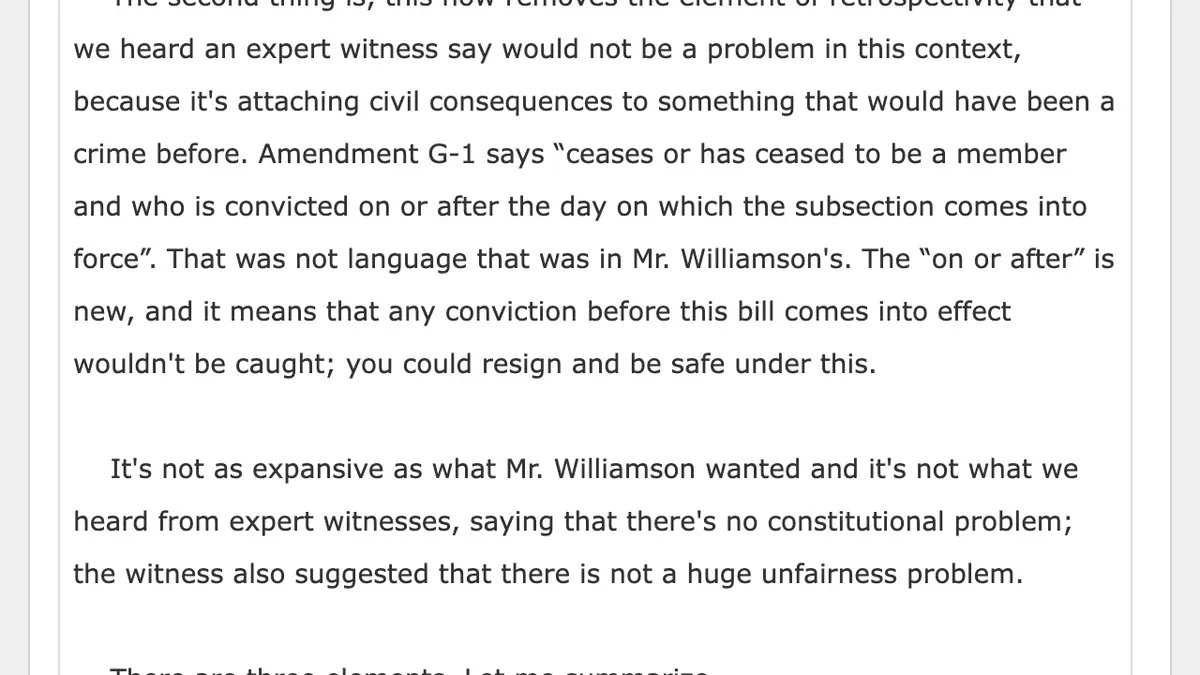
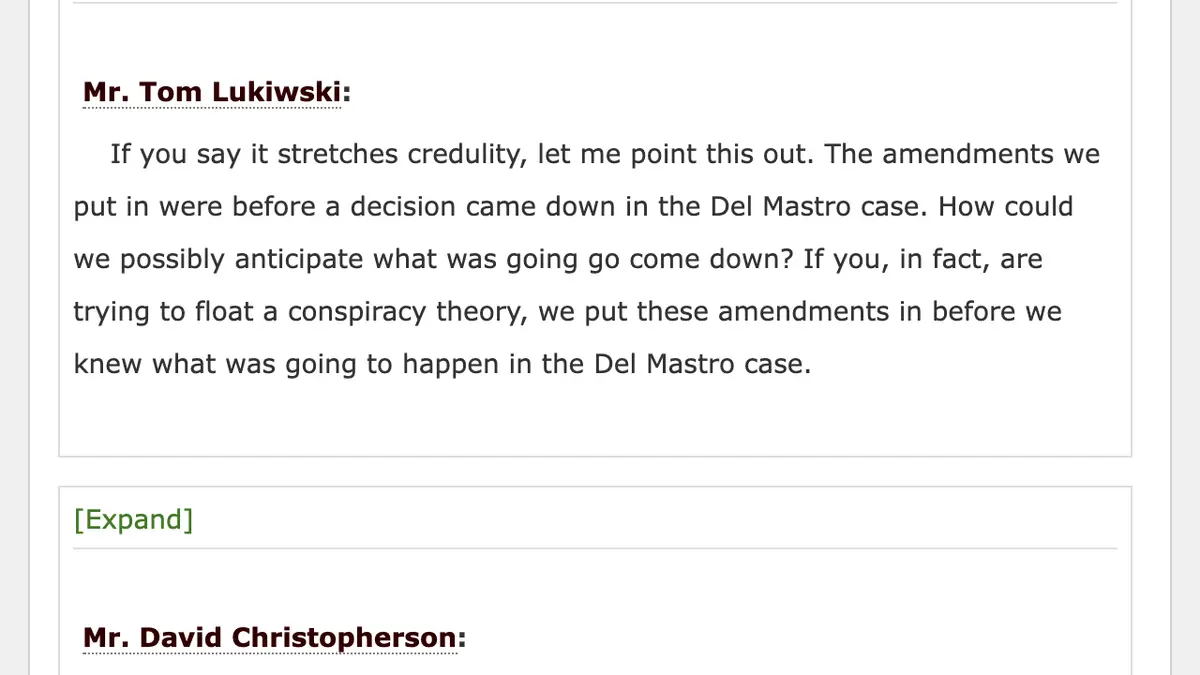
He resigned with a motion to suspend him before the House. The day before, 4 November, the Commons procedure committee had taken up a bill to withdraw the pension of an MP convicted of certain offences. The government's amendment limited it to a list of Criminal Code offences, and to convictions "on or after" the day it came into force. Under those words, the NDP's Craig Scott told the committee, "you could resign and be safe under this." His change to add Canada Elections Act offences was voted down, and the government's amendment carried. Tom Lukiwski, for the government: "I can assure you that this does not have anything to do with the Dean Del Mastro case." That afternoon the Speaker found a prima facie case of privilege, and the NDP moved to suspend him. The government's House Leader called for "suspension pending the completion of all appeals."
The pension bill passed the House in February 2015 and was still in the Senate when the session ended in August. It never became law. Writs for a Peterborough by-election were withdrawn on 2 August 2015, and the seat stayed empty to the end of that Parliament.
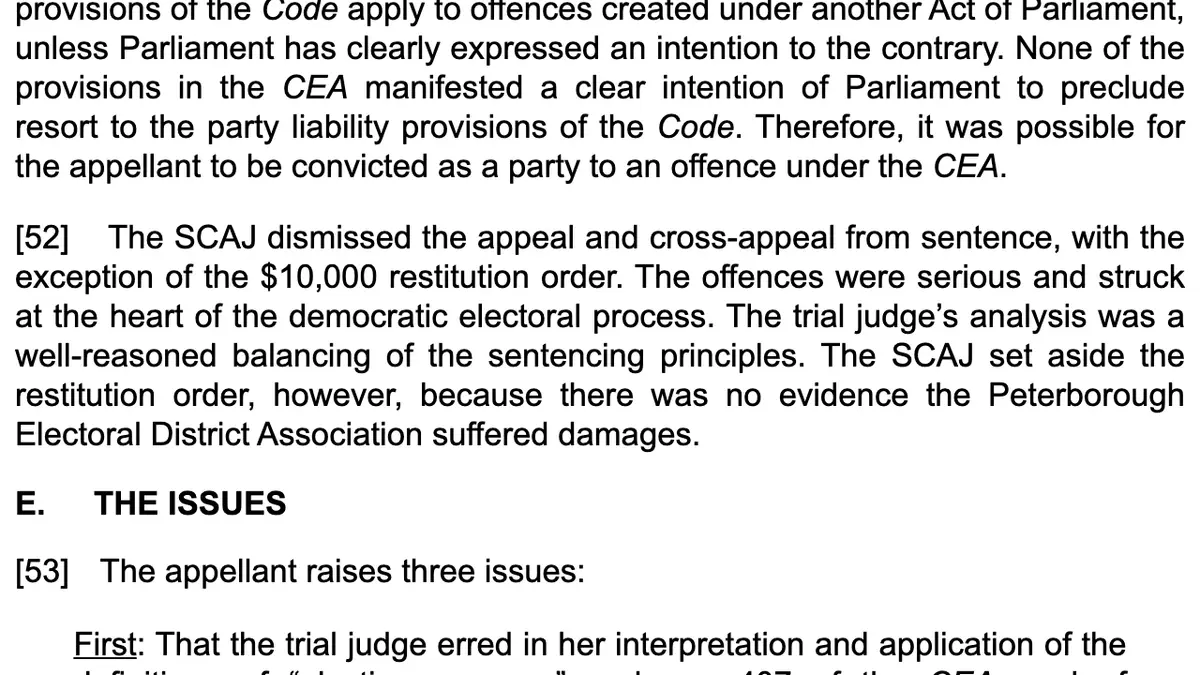
The sentence was 30 days in jail, a 4-month conditional sentence and 18 months' probation. The first appeal judge upheld the convictions; the offences, that judge wrote, "struck at the heart of the democratic electoral process." A $10,000 restitution order to his riding association was set aside, because there was no evidence the association lost anything.
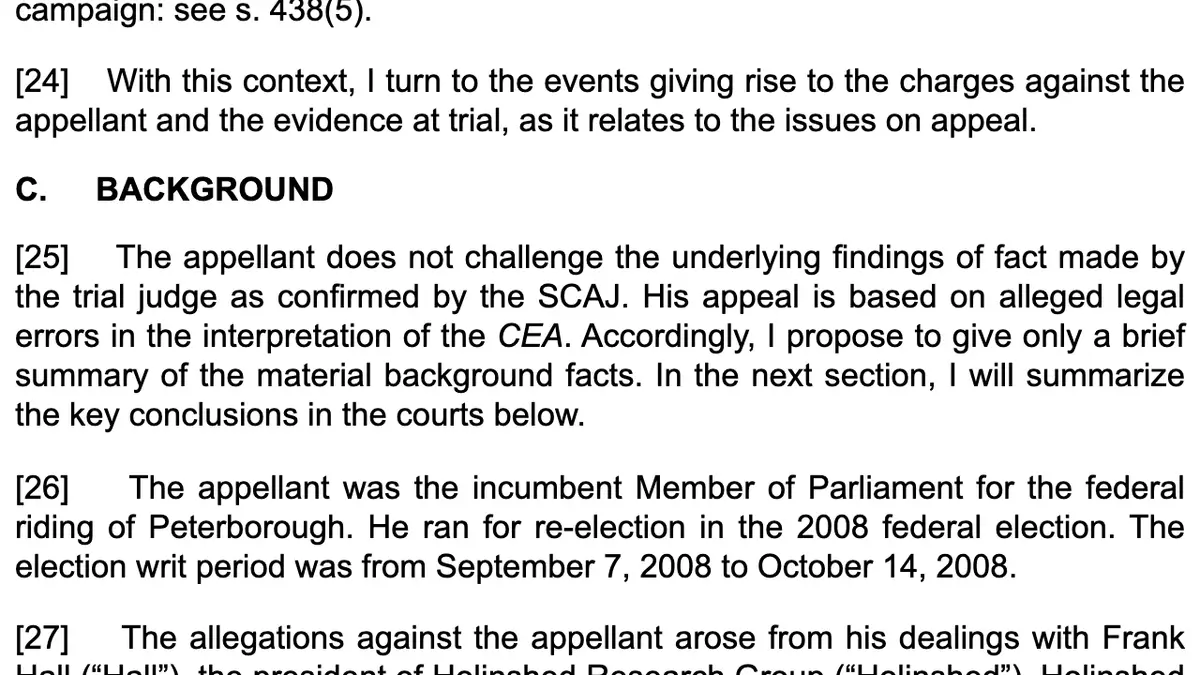
At the Court of Appeal he no longer fought the facts. "The appellant does not challenge the underlying findings of fact made by the trial judge," the court wrote on 13 September 2017. He dropped his sentence appeal in oral argument. The court dismissed the appeal. On 5 April 2018 the Supreme Court of Canada refused to hear him.
A trial court convicted him, and two appeal courts upheld the convictions.
Their side
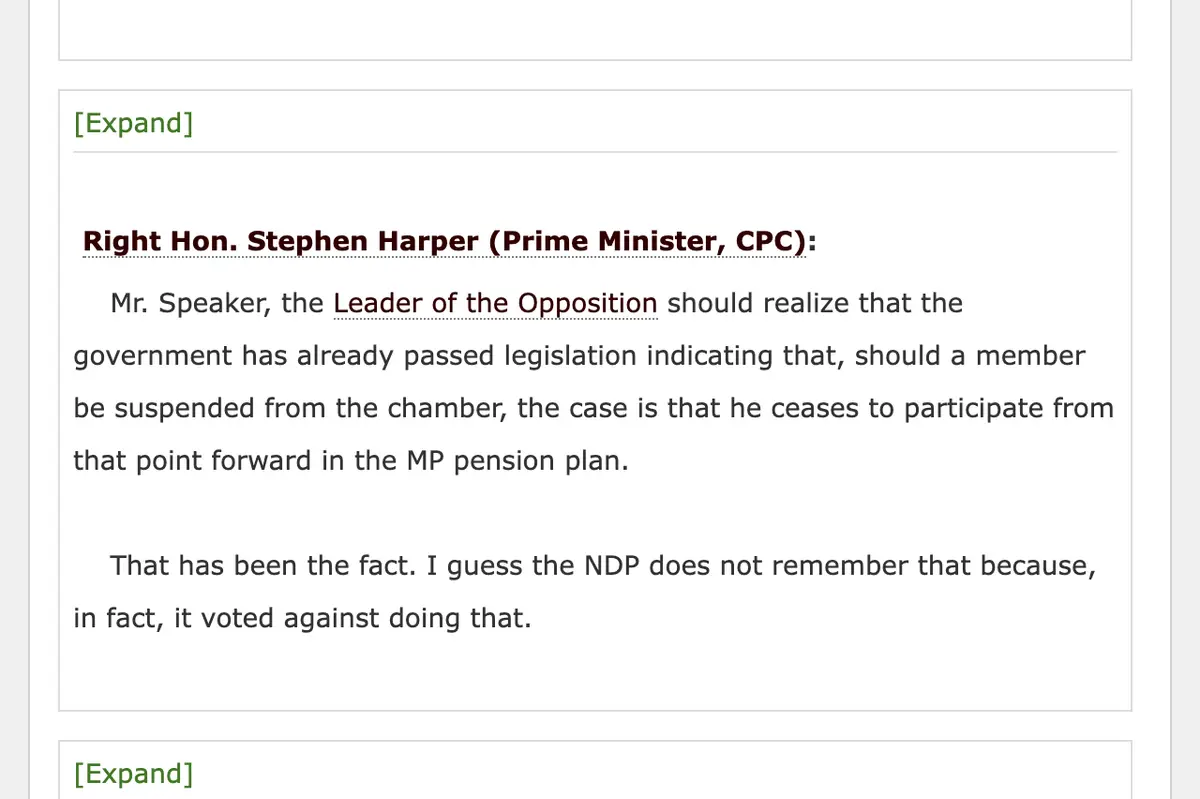
He told the House on 5 November 2014 that the case was still before the courts, that he "did not donate too much money" to himself, and that what he had heard the day before, "that somehow this was a means of stealing an election", was "absolutely false". At trial his defence was that the supplier's invoice did not reflect his discussions with the supplier and was signed in error. The trial judge had reservations about the supplier's evidence, and said gaps in the investigation "may not reflect well on the quality of the investigation". The first appeal judge found the trial judge erred in drawing an adverse inference from the failure to call one witness, John McNutt. On the pension bill, the government's case is in its own words. Tom Lukiwski told the committee the amendment "does not have anything to do with the Dean Del Mastro case", that it was put in before the verdict, and that it "expands the list of offences" and drops the test by sentence. The Prime Minister said a member suspended from the House already stops taking part in the pension plan, and that "we expect the member will be suspended without pay." The NDP's Craig Scott said the bill as first written "might not catch him at all anyway". On his post, the record is the government's best case. On 19 September 2013, before the charges of 26 September, an order replaced the whole slate of parliamentary secretaries for a new term, moved him off the Prime Minister's post to the regional development agencies, and gave the Prime Minister's post to Paul Calandra. He was removed from the new post the day after the charges. The order gives no reason for the move.
- House of Commons: House of Commons Debates, 41st Parliament, 2nd Session, No. 139, Resignation of Member, 15:20
- Court of Appeal for Ontario: R. v. Del Mastro, 2017 ONCA 711, para. 40
- Ontario Court of Justice: R. v. Del Mastro, 2014 ONCJ 605, reasons for judgment, the defence and the investigation
All 9 sources
- Court of Appeal for Ontario: R. v. Del Mastro, 2017 ONCA 711, para. 50
- Court of Appeal for Ontario: R. v. Del Mastro, 2017 ONCA 711, para. 50
- House of Commons, Standing Committee on Procedure and House Affairs: Evidence, 41st Parliament, 2nd Session, meeting 55, Tom Lukiwski, on NDP-3 and G-1
- House of Commons: House of Commons Debates, 41st Parliament, 2nd Session, No. 138, Oral Questions, Ethics, the Prime Minister's second answer
- House of Commons, Standing Committee on Procedure and House Affairs: Evidence, 41st Parliament, 2nd Session, meeting 55, Craig Scott, on amendment G-1
- Privy Council Office: Order in Council P.C. 2013-923, the operative words
The answer
Our read: no court found the calls changed who won Peterborough, and this story does not say they did. The law caps the spending whatever the result. On everything else, the courts heard his case and rejected it. The trial judge rejected his evidence on key issues. The first appeal judge found the trial judge erred in drawing an adverse inference from one witness not being called, and applied the curative proviso: there was "no substantial wrong or miscarriage of justice." At the Court of Appeal he stopped contesting the facts, and the Supreme Court would not hear him. The defence account does not explain a cheque back-dated to before the writ, or a false invoice.
On the pension bill, the government may well have drafted its amendment before the verdict, as it said. What the amendment did is in its words: Criminal Code offences only, and convictions on or after the day it came into force. Our read: on its face it could not reach him, and the committee voted down the change that would have brought the Elections Act back in. No document shows why that text was chosen.
What we are chasing
- Did Elections Canada ever seek back any of the $54,593 reimbursed for a campaign the courts found broke the limit?Would settle it: Elections Canada's file on the Peterborough candidate's return for the 2008 election, with any amended return or recovery; by an access request to Elections Canada.
- When did the Prime Minister's Office learn of the Elections Canada investigation, and why was he moved off the Prime Minister's post on 19 September 2013, before the charges of 26 September?Would settle it: Privy Council Office and Prime Minister's Office records on the slate of 19 September 2013 and the order of 27 September 2013 ending his appointment, by an access request; and the court file behind Elections Canada's production orders.
- Does he draw an MP's pension, and did resigning on 5 November 2014, with a motion to suspend him before the House, leave it whole?Would settle it: The pension administrator's record under the Members of Parliament Retiring Allowances Act, or his own public words on it.
- What party support did he expect in 2008, and why did it not come?Would settle it: The Conservative Party's 2008 election return and the Peterborough riding association's returns for 2008, in Elections Canada's political financing records.
The receipts
Each fact with its document and date. Tap a figure for its source.
The cheque
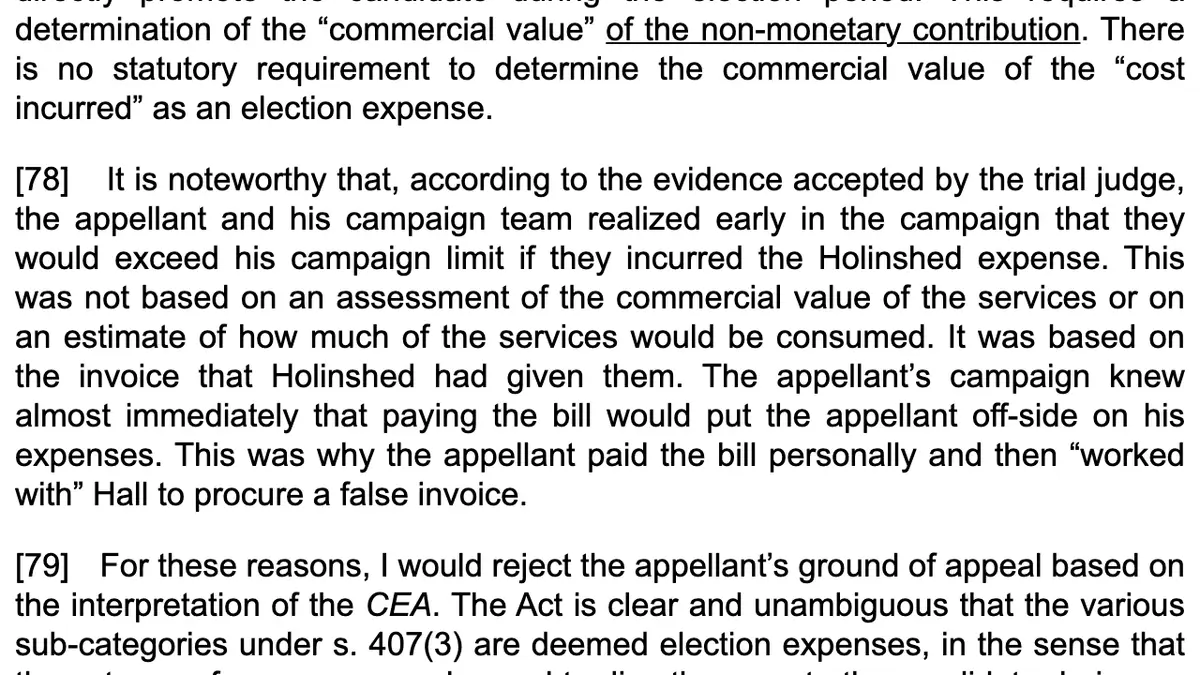
- The court said the election expense limits give those seeking office a level playing field. “The election expense limits provide a level playing field for those seeking elected office”Court of Appeal for Ontario, para. 13 (2017-09-13) ↗
2 more receipts, 2 to 3
- In 2008 the campaign expense limit in Peterborough was $92,566. “In 2008, the limit applicable to the Peterborough riding was $92,566.”Court of Appeal for Ontario, para. 13, on the limit on expenses a candidate may incur during an election campaign (2017-09-13) ↗
- The law also capped what a candidate could personally contribute to his own campaign, at $2,100. “Second, the CEA also limits the amount that a candidate may personally contribute to his or her campaign. In 2008, the limit was $2,100.”Court of Appeal for Ontario, para. 13 (2017-09-13) ↗
- He first passed on the supplier's quote because he thought the Conservative Party would provide similar services, the Court of Appeal recorded. When that party support did not come, early in the campaign, he went back to the supplier. “Shortly after the start of the election, when the anticipated party support was not forthcoming, the appellant renewed discussions with Hall”Court of Appeal for Ontario, para. 29 (2017-09-13) ↗
- On 15 September 2008 his campaign signed a contract with Holinshed Research Group for voter identification and get-out-the-vote calls worth $21,000. “a September 15th $21,000 contract with Holinshed Research Group for election services”Ontario Court of Justice, reasons for judgment, the Holinshed contract (2014-10-31) ↗
2 more receipts, 6 to 7
- His official agent first moved to pay the invoice from the campaign account. The campaign soon realized it would put him over the limit, told the supplier it could not pay, and the calls stopped. “It was soon realized, however, that the payment of Holinshed’s invoice would put the appellant’s campaign over his expense limit.”Court of Appeal for Ontario, para. 30 (2017-09-13) ↗
- He promised full payment, the calling resumed, and he paid from his personal account. “promised full payment of the $21,000 contract and calling resumed. At that point Del Mastro made the payment of $21,000 from his personal account.”Ontario Court of Justice, reasons for judgment, the payment (2014-10-31) ↗
- The trial judge accepted the supplier's evidence that on 2 October 2008 he said he would pay for the calling himself, and asked the supplier to "work with" him on the invoicing. “The appellant asked Hall to “work with” him on the invoicing for Holinshed’s services.”Court of Appeal for Ontario, para. 31 (2017-09-13) ↗
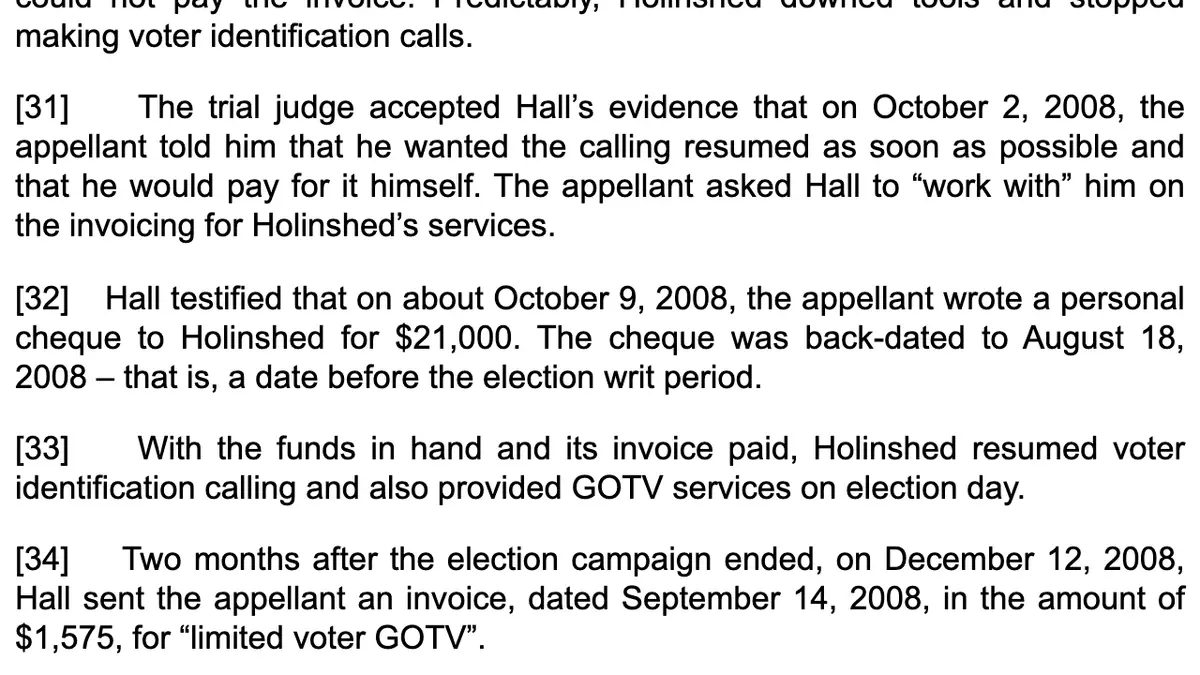
- He wrote the cheque on about 9 October 2008 and back-dated it to 18 August, a date before the election writ period. “The cheque was back-dated to August 18, 2008 – that is, a date before the election writ period.”Court of Appeal for Ontario, para. 32 (2017-09-13) ↗
2 more receipts, 10 to 11
- His campaign knew almost immediately that paying the bill would put him over his expense limit. “The appellant’s campaign knew almost immediately that paying the bill would put the appellant off-side on his expenses.”Court of Appeal for Ontario, para. 78 (2017-09-13) ↗
- That, the court found, is why he paid it himself and worked with the supplier to get a false invoice. “This was why the appellant paid the bill personally and then “worked with” Hall to procure a false invoice.”Court of Appeal for Ontario, para. 78 (2017-09-13) ↗
His campaign knew the bill would put him over, and the money went off the books: his own cheque, back-dated before the writ, and a false invoice.
The return
- His return listed $1,575 paid to Holinshed. His $21,000 was not reported. Expenses totalled $91,770, against a limit of $92,566. “His personal payment of $21,000 was not reported.”Court of Appeal for Ontario, para. 36 (2017-09-13) ↗
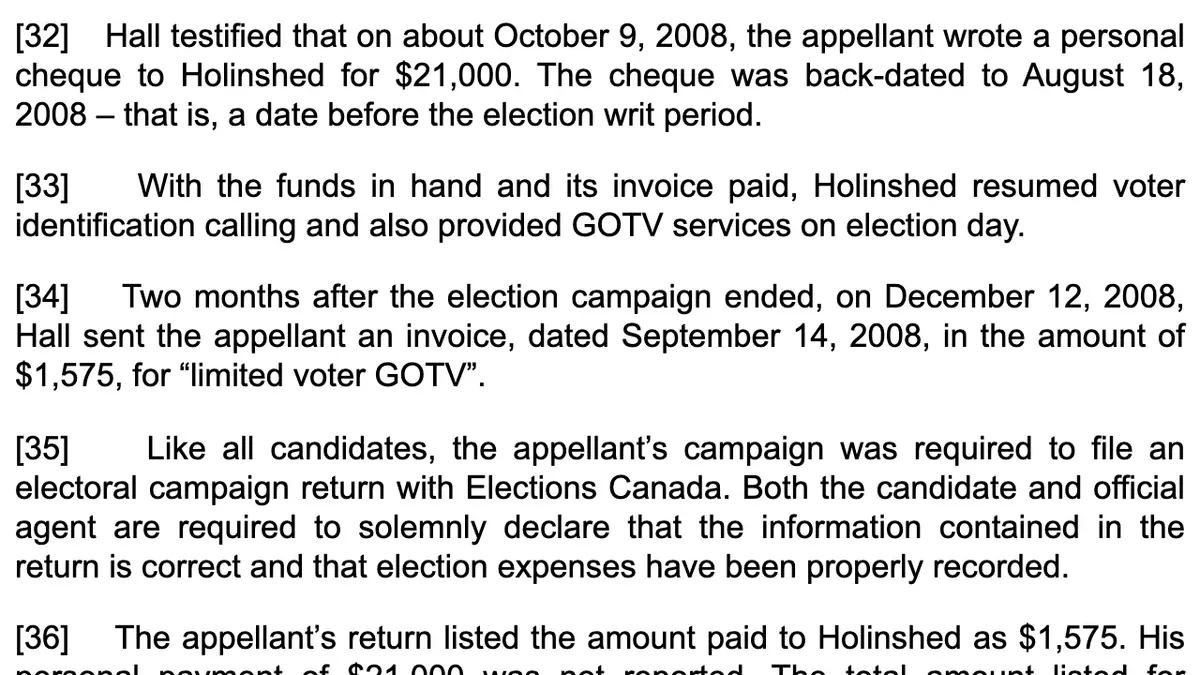
- The invoice for the $1,575 came after the election, on 12 December 2008, for "limited voter GOTV". It was dated 14 September 2008. “Hall sent the appellant an invoice, dated September 14, 2008, in the amount of $1,575, for “limited voter GOTV”.”Court of Appeal for Ontario, para. 34 (2017-09-13) ↗
- Our arithmetic: count his $21,000 in place of the $1,575, and his expenses come to $111,195. That is $18,629 over the $92,566 limit. “The total amount listed for election campaign expenses was $91,770”Court of Appeal for Ontario, para. 36 (2017-09-13) ↗
- He signed the return's solemn declaration on 10 February 2009. “The appellant signed the solemn declaration on February 10, 2009 and McCarthy signed it on February 11, 2009.”Court of Appeal for Ontario, para. 36 (2017-09-13) ↗
2 more receipts, 16 to 17
- After the election, the trial judge found, he kept trying to fold the calling into other contracts, producing a misleading statement of expenses. “Del Mastro's continuing efforts to absorb some of the election expense of the Holinshed Voter ID and GOTV work into other contracts”Ontario Court of Justice, reasons for judgment, after the election (2014-10-31) ↗
- Elections Canada reimbursed $54,593 of his 2008 election expenses from public money. “"Del Mastro, Dean" 35071 Peterborough Conservative "54,592.51"”Elections Canada, the row "Del Mastro, Dean", 35071 Peterborough, column "Reimbursement Amount ($)" ↗
A return just under the limit, signed under solemn declaration, with his own cheque left off it. The public paid its share of the expenses.
What the government told the House in June 2012
- On 13 June 2012 the Liberal MP Bob Rae put the cheque to the Prime Minister in the House. “parliamentary secretary has admitted that he wrote a cheque for $21,000 prior to the election to a company called the Holinshed Research Group.”House of Commons, Oral Questions, Ethics, Hon. Bob Rae (2012-06-13) ↗
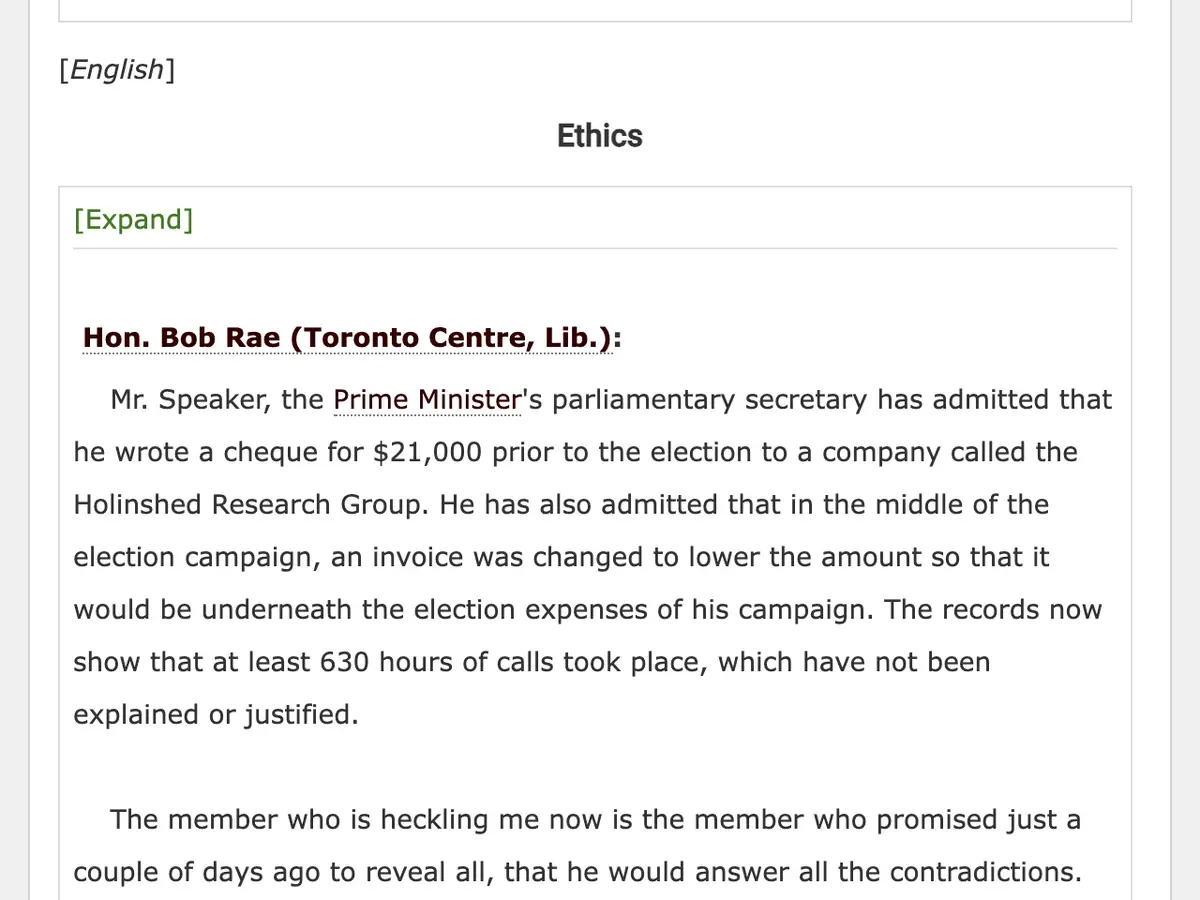
- Stephen Harper answered that his parliamentary secretary had given Elections Canada all of his information. “as we all know, the hon. member for Peterborough has submitted all of his information to Elections Canada.”House of Commons, Oral Questions, Ethics, 14:30, the Prime Minister (2012-06-13) ↗
- Pierre Poilievre, a parliamentary secretary answering for the government, told the House he "has followed all of the rules." “The hon. member for Peterborough has followed all of the rules. He has submitted the documents. They have been audited and verified.”House of Commons, Oral Questions, Ethics, 15:00, Pierre Poilievre (2012-06-13) ↗
By June 2012 the cheque was a question in the House. The government's answer was that he had followed all of the rules. The return those answers stood on left the cheque off.
Moved off the Prime Minister's post, then removed the day after the charges
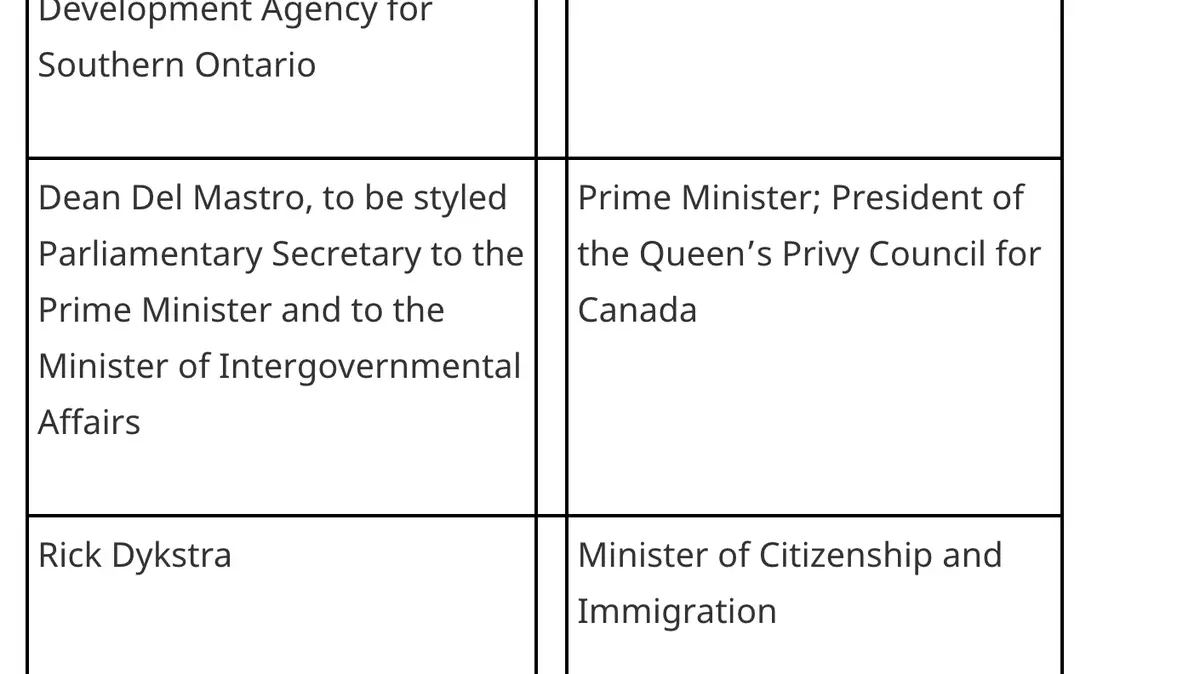
- On 25 May 2013 he was reappointed the Prime Minister's parliamentary secretary, for a period ending on 24 May 2014. “Dean Del Mastro, to be styled Parliamentary Secretary to the Prime Minister and to the Minister of Intergovernmental Affairs”Privy Council Office, the slate effective 25 May 2013, for a period ending on 24 May 2014 (2013-05-22) ↗
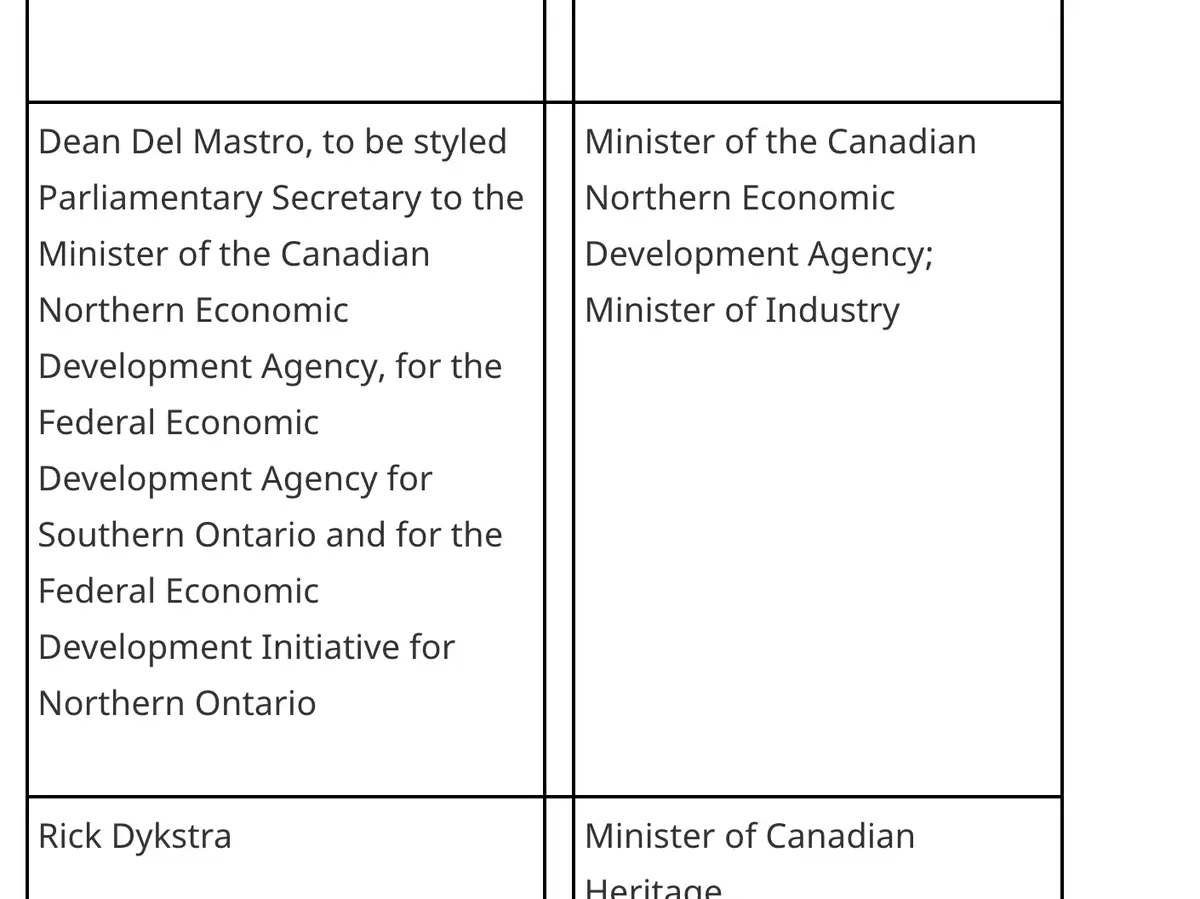
- On 19 September 2013, on the Prime Minister's recommendation, an order in council replaced that slate. It moved him off the Prime Minister's post, to be parliamentary secretary to the Minister of the Canadian Northern Economic Development Agency. “Dean Del Mastro, to be styled Parliamentary Secretary to the Minister of the Canadian Northern Economic Development Agency”Privy Council Office, the slate effective 19 September 2013, for a period ending on 18 September 2014 (2013-09-19) ↗
2 more receipts, 23 to 24
- The same post covered the federal development agency for Southern Ontario and the initiative for Northern Ontario. “for the Federal Economic Development Agency for Southern Ontario and for the Federal Economic Development Initiative for Northern Ontario”Privy Council Office, the slate effective 19 September 2013, his entry (2013-09-19) ↗
- The same order gave the Prime Minister's post to Paul Calandra. It gives no reason for the move. “Paul Calandra, to be styled Parliamentary Secretary to the Prime Minister and for Intergovernmental Affairs”Privy Council Office, the slate effective 19 September 2013 (2013-09-19) ↗
- On 26 September 2013 the Commissioner of Canada Elections charged him with paying an election expense of $21,000 out of his own funds, and so wilfully exceeding the $2,100 limit on his own contribution. “an election expense of $21,000.00 out of his own funds, thereby making a contribution and, in so doing, wilfully exceeded the contribution limit of $2,100.00”Commissioner of Canada Elections, Charge no. 2 (2013-09-26) ↗
- His official agent, Richard McCarthy, was charged with him on the expense limit and on the return. “Richard McCarthy, being the official agent of candidate Dean Del Mastro”Commissioner of Canada Elections, Charges no. 1, 3 and 4 (2013-09-26) ↗
2 more receipts, 27 to 28
- They were charged with wilfully incurring election expenses over the limit. “incur election expenses in an amount that was more than the election expenses limit”Commissioner of Canada Elections, Charge no. 1 (2013-09-26) ↗
- And over a return that left out the $21,000 and reported $1,575 in its place. These were the charges as laid; the findings came at trial. “omitted to report an election expense of $21,000.00 and instead reported an election expense of $1,575.00”Commissioner of Canada Elections, Charges no. 3 and 4 (2013-09-26) ↗
- On 27 September 2013, the day after the charges, an order in council on the Prime Minister's recommendation ended his appointment as parliamentary secretary to the ministers for northern economic development and for Industry. “the appointment of Dean Del Mastro as Parliamentary Secretary to the Minister of the Canadian Northern Economic Development Agency and to the Minister of Industry”Privy Council Office, the order of 27 September 2013 (2013-09-27) ↗
The Prime Minister's parliamentary secretary from May 2011, with the cheque a question in the House from June 2012, reappointed in May 2013. Moved to the regional agencies on 19 September 2013, with no reason in the order. Charged on 26 September. Removed the day after the charges.
The verdict
- The trial judge rejected his evidence on key issues. “led to reject Mr. Del Mastro's evidence on key issues”Ontario Court of Justice, reasons for judgment, credibility (2014-10-31) ↗
3 more receipts, 31 to 33
- The judge said the way he testified at times suggested he was avoiding the truth. “At times, the way in which he testified led me to believe that he was avoiding the truth.”Ontario Court of Justice, reasons for judgment, credibility (2014-10-31) ↗
- The judge wrote that he frequently obfuscated the evidence. “He frequently obfuscated the evidence.”Ontario Court of Justice, reasons for judgment, credibility (2014-10-31) ↗
- On 31 October 2014 the trial court found him guilty of incurring election expenses over the campaign limit. “I find that Del Mastro is guilty of count one, incurring election expenses that exceeded the campaign limit”Ontario Court of Justice, reasons for judgment, verdict (2014-10-31) ↗
- He was also convicted of wilfully exceeding his personal contribution limit. “He was convicted of exceeding his election expense limit (count one), of wilfully exceeding his personal contribution limit (count two)”Court of Appeal for Ontario, para. 2 (2017-09-13) ↗
- And the trial judge found him guilty, as a party, of filing a false or misleading return. “She found him guilty on count three, as a party to filing a false or misleading electoral campaign return”Court of Appeal for Ontario, para. 46 (2017-09-13) ↗
4 more receipts, 36 to 39
- He was sentenced to 30 days in jail, a 4-month conditional sentence and 18 months' probation. A $10,000 restitution order to his riding association was set aside on the first appeal. “He was sentenced to 30 days in jail together with a four month conditional sentence and 18 months’ probation.”Court of Appeal for Ontario, para. 2 (2017-09-13) ↗
- The first appeal judge said the offences struck at the heart of the electoral process. “struck at the heart of the democratic electoral process.”Court of Appeal for Ontario, para. 52, quoting the first appeal (2016 ONSC 2071) (2017-09-13) ↗
- At the Court of Appeal he did not challenge the facts, and he dropped his sentence appeal in oral argument. The appeal was dismissed on 13 September 2017. “The appellant does not challenge the underlying findings of fact made by the trial judge as confirmed by the SCAJ.”Court of Appeal for Ontario, paras. 4, 8 and 25 (2017-09-13) ↗
- On 5 April 2018 the Supreme Court of Canada refused to hear his appeal. “Number C61958, 2017 ONCA 711, dated September 13, 2017, is dismissed.”Supreme Court of Canada, docket entry, 2018-04-05 (2018-04-05) ↗
A judge who rejected his evidence, two appeal courts that upheld the convictions, and a Supreme Court that would not hear him. By the end he no longer disputed the facts.
The office
- He was parliamentary secretary to the Minister of Canadian Heritage from 7 November 2008 to 26 March 2011. “Parliamentary Secretary to the Minister of Canadian Heritage”House of Commons, Parliamentary Secretary roles, 40th Parliament ↗
3 more receipts, 41 to 43
- He was parliamentary secretary to the Prime Minister from 25 May 2011 to 19 September 2013, under yearly orders. The first ran to 24 May 2012. “Dean Del Mastro, to be styled Parliamentary Secretary to the Prime Minister and to the Minister of Intergovernmental Affairs”Privy Council Office, the slate effective 25 May 2011 (2011-05-25) ↗
- The order of 24 May 2012 reappointed him for 25 May 2012 to 24 May 2013. “Dean Del Mastro, to be styled Parliamentary Secretary to the Prime Minister and to the Minister of Intergovernmental Affairs”Privy Council Office, the slate effective 25 May 2012, for a period ending on 24 May 2013 (2012-05-24) ↗
- The order of 22 May 2013 reappointed him from 25 May 2013, until the order of 19 September 2013 replaced it. “Dean Del Mastro, to be styled Parliamentary Secretary to the Prime Minister and to the Minister of Intergovernmental Affairs”Privy Council Office, the slate effective 25 May 2013, for a period ending on 24 May 2014 (2013-05-22) ↗
- He sat as a Conservative to 30 September 2013, then as an independent until his seat ended on 5 November 2014. “Conservative Independent”House of Commons, Political affiliation, 41st Parliament ↗
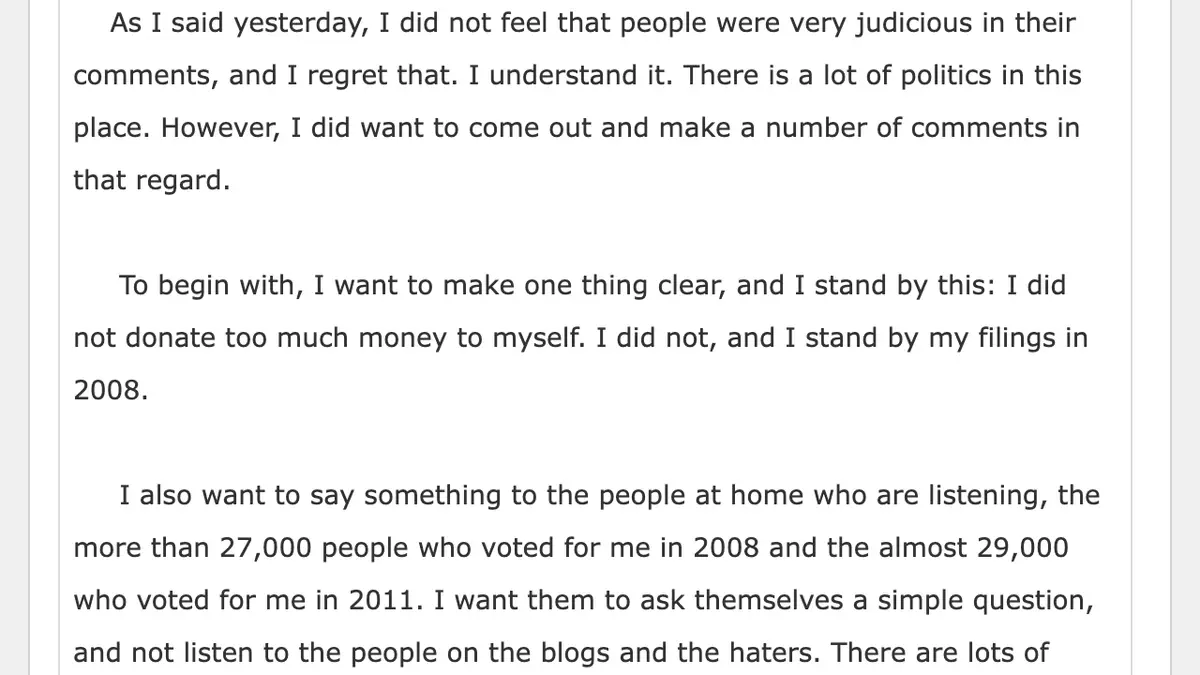
- On 5 November 2014, five days after the verdict and sitting as an independent, he told the House he stood by his 2008 filings, and resigned his seat. “I did not donate too much money to myself. I did not, and I stand by my filings in 2008.”House of Commons, Resignation of Member, 15:15 to 15:20 (2014-11-05) ↗
Parliamentary secretary to the Prime Minister from 2011 to 2013. In November 2014, an independent five days past the verdict, still standing by the return.
The pension bill, the morning before he resigned
- On the morning of 4 November 2014 the Commons procedure committee took up a private member's bill to withdraw the pension of an MP convicted of certain offences. “Protecting Taxpayers and Revoking Pensions of Convicted Politicians Act”Parliament of Canada, short title and committee stage ↗
- The government's amendment, G-1, limited the offences to a list from the Criminal Code. “In subsection (2) “offence” means an offence under any of the following provisions of the Criminal Code”House of Commons, Standing Committee on Procedure and House Affairs, Craig Scott, reading amendment G-1, subsection (4) (2014-11-04) ↗
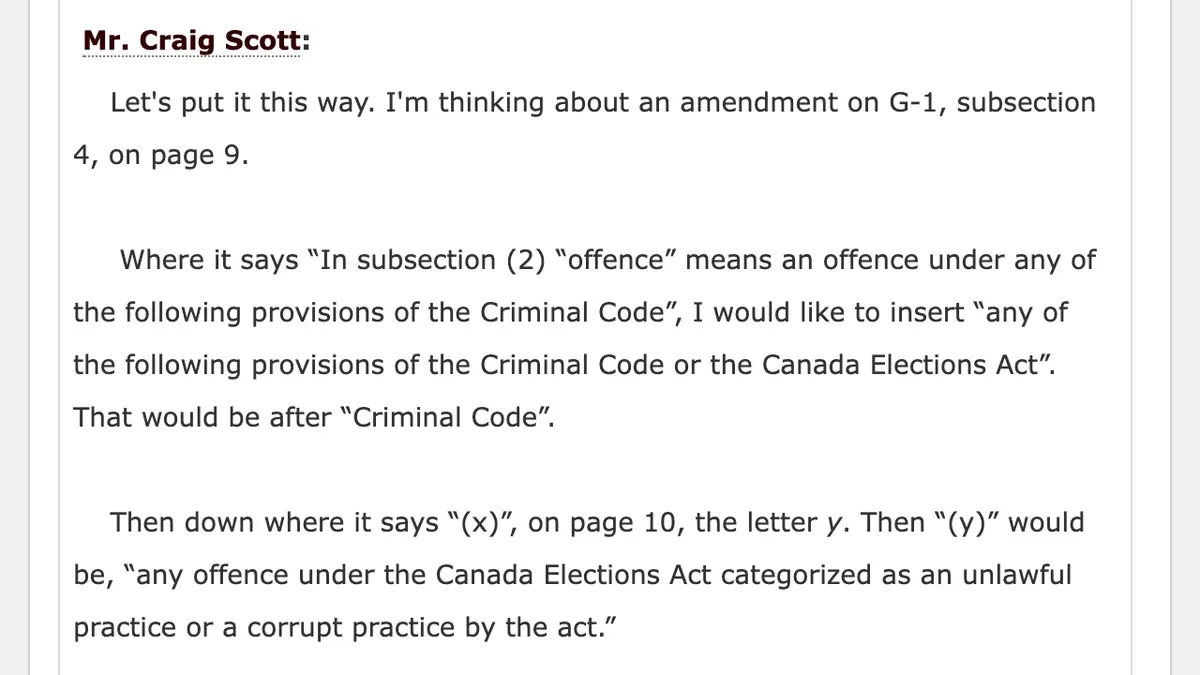
- It also covered only convictions on or after the day it came into force. The NDP's Craig Scott told the committee that meant "you could resign and be safe under this." “it means that any conviction before this bill comes into effect wouldn't be caught; you could resign and be safe under this.”House of Commons, Standing Committee on Procedure and House Affairs, Craig Scott, on amendment G-1 (2014-11-04) ↗
3 more receipts, 49 to 51
- Scott moved to add Canada Elections Act offences to the list. The committee voted it down. “(Subamendment negatived: nays 5; yeas 4 [See Minutes of Proceedings ])”House of Commons, Standing Committee on Procedure and House Affairs, the subamendment to G-1 and its recorded vote (2014-11-04) ↗
- Then it carried the government's amendment. “(Amendment agreed to: yeas 5 ; nays 4 [See Minutes of Proceedings ])”House of Commons, Standing Committee on Procedure and House Affairs, amendment G-1, recorded vote (2014-11-04) ↗
- Tom Lukiwski, for the government, told the committee the amendment had nothing to do with him. “I can assure you that this does not have anything to do with the Dean Del Mastro case.”House of Commons, Standing Committee on Procedure and House Affairs, Tom Lukiwski, 11:15 (2014-11-04) ↗
- Lukiwski said the government's amendments were put in before the verdict. “we put these amendments in before we knew what was going to happen in the Del Mastro case.”House of Commons, Standing Committee on Procedure and House Affairs, Tom Lukiwski, in reply to David Christopherson (2014-11-04) ↗
- That afternoon the Leader of the Opposition, Thomas Mulcair, said in the House that the amendment would help only him. “would only help one person, the member of Parliament for Peterborough”House of Commons, Oral Questions, Ethics, 14:20, Hon. Thomas Mulcair (2014-11-04) ↗
4 more receipts, 54 to 57
- The Prime Minister answered that a member suspended from the House already stops taking part in the MP pension plan. “should a member be suspended from the chamber, the case is that he ceases to participate from that point forward in the MP pension plan.”House of Commons, Oral Questions, Ethics, the Prime Minister (2014-11-04) ↗
- The Speaker found a prima facie case of privilege over his conviction. “it is evident to me that this is a prima facie case of privilege”House of Commons, Privilege, the Speaker's ruling (2014-11-04) ↗
- The NDP moved to suspend him from his seat, his committees and his sessional allowance. “the right to collect his sessional allowance as a member of Parliament”House of Commons, Privilege, motion by Peter Julian (2014-11-04) ↗
- The government's House Leader, Peter Van Loan, called for suspension until his appeals were done. “The appropriate disposition is suspension pending the completion of all appeals.”House of Commons, Privilege, debate, Hon. Peter Van Loan (2014-11-04) ↗
- The next afternoon, after his statement, the Speaker announced his resignation and the vacancy. “Mr. Del Mastro, member for the electoral district of Peterborough, having resigned, it is my duty to inform the House that a vacancy has occurred”House of Commons, Vacancy, Peterborough, 15:25 (2014-11-05) ↗
- The pension bill passed the House on 4 February 2015. It was still at report stage in the Senate when the session ended on 2 August 2015, and never became law. “At report stage in the Senate”Parliament of Canada, current status; third reading ↗
- Writs for a Peterborough by-election, issued on 3 May 2015 for 19 October, were withdrawn on 2 August 2015. The seat stayed empty to the end of that Parliament. “the writs issued on May 3, 2015, for federal by-elections to be held in the following electoral districts on October 19, 2015”Chief Electoral Officer, notice dated 2 August 2015; Peterborough, Ontario (2015-08-06) ↗
The morning before he resigned, the government rewrote a pension bill to reach only a list of Criminal Code offences, and only convictions from then on, and said it had nothing to do with him. The next afternoon he resigned, with a motion to suspend him before the House.
- Published.
- Added the record's own pages beside the text, cropped to the quoted words and marked.
- Folded long lists behind their count.
- The official's page now shows this story's opening, with a link here.